
 Search

 Sign In


New Report: Balancing Sustainability with Speed to Market in the Data Center “Gold Rush”
Identifies five risks developers must address to remain competitive in an AI-driven market
January 15, 2026 | Washington, D.C.
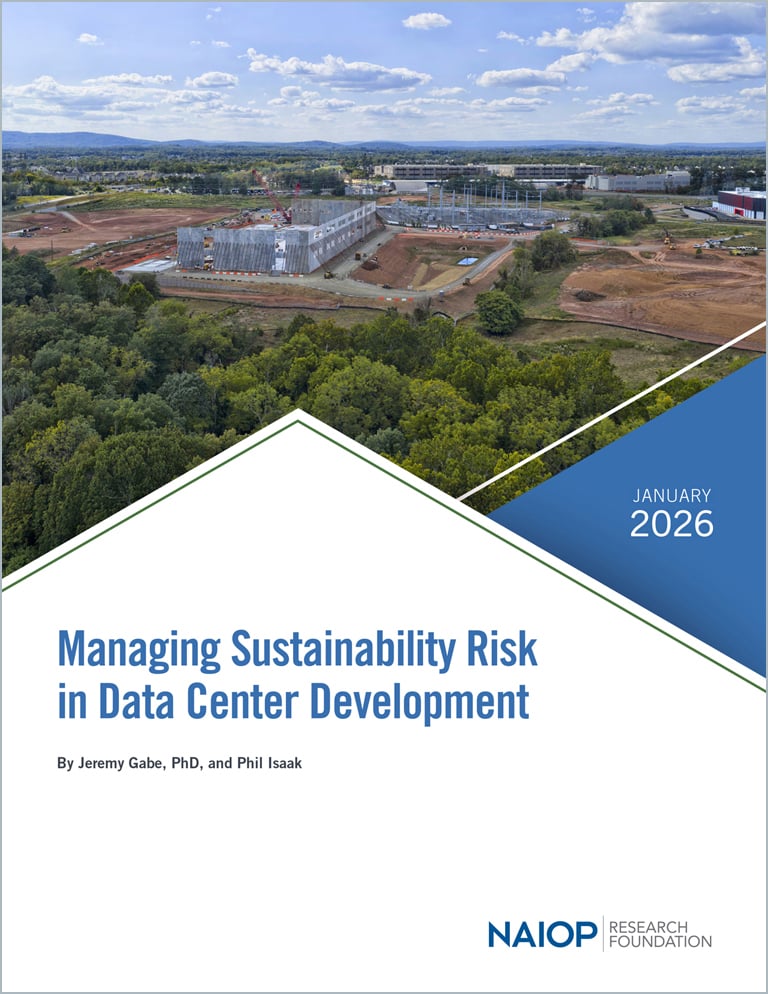
As demand for hyperscale and colocation data centers continues to surge, driven by generative AI, machine learning and other power-intensive technologies, the development teams behind these properties must balance three competing priorities: meeting market requirements, acquiring adequate power, and managing near-term and long-term sustainability risk.
A new report from the NAIOP Research Foundation, “Managing Sustainability Risk in Data Center Development,” explores how developers and investors can maintain long-term financial returns by addressing emerging sustainability concerns in these projects.
The authors identified five major sustainability concerns that should be addressed for new data centers to maintain their market competitiveness:
- Physical risk resilience. Mitigating risks posed by extreme weather and natural disasters.
- Energy efficiency. Reducing carbon emissions and costs from inefficiencies, making data centers more attractive to occupiers.
- Community integration and engagement. Addressing concerns about power and water use and minimizing unfavorable impacts on adjacent communities.
- Decarbonization. Maintaining the ability to switch to low-carbon or carbon-free energy sources for tenants and investors with emission-reduction objectives.
- Conversion from air-cooled to liquid-cooled IT equipment. Adopting design that allows for the installation of liquid-cooling, which is both more energy efficient than traditional air cooling and is often required for state-of-the-art chipsets.
"For new data center projects, sustainability isn't just a question of positioning a property to attract tenants or investors who have long-term environmental objectives. Developers increasingly have to address community concerns about how a data center will impact local utility rates, the water supply, or the stability of the electric grid," said Shawn Moura, Ph.D., executive director of the NAIOP Research Foundation. "This report provides developers with strategies for securing the power needed for new data centers, getting them entitled, and ensuring they will remain competitive over a typical investment horizon."
“Managing Sustainability Risk in Data Center Development” is authored by Jeremy Gabe, Ph.D., the Capstone Advisors Endowed Professor of Real Estate at the University of San Diego Knauss School of Business; and Phil Isaak, PE, P.Eng., DCDC, RCDD, SMIEE, a data center infrastructure engineer and program/project manager with more than 20 years of experience.
# # #
About the NAIOP Research Foundation
The NAIOP Research Foundation was established in 2000 as a 501(c)(3) organization to support the work of individuals and organizations engaged in real estate development, investment and operations. The Foundation’s core purpose is to provide information about how real properties impact and benefit communities throughout North America. For more information, visit naiop.org/researchfoundation.
About NAIOP
NAIOP, the Commercial Real Estate Development Association is the leading organization for developers, owners, investors and related professionals in office, industrial, retail, and mixed-use real estate. NAIOP provides unparalleled industry networking and education and advocates for effective legislation on behalf of our members. NAIOP advances responsible, sustainable development that creates jobs and benefits the communities in which our members work and live. For more information, visit naiop.org.
NAIOP Contact:
Brielle Scott, NAIOP director of marketing and communications
703-674-1437
scott@naiop.org