 Search

 Sign In


CoStar Group Industrial Market Report - Detroit
December 08, 2025 | Detroit, Michigan
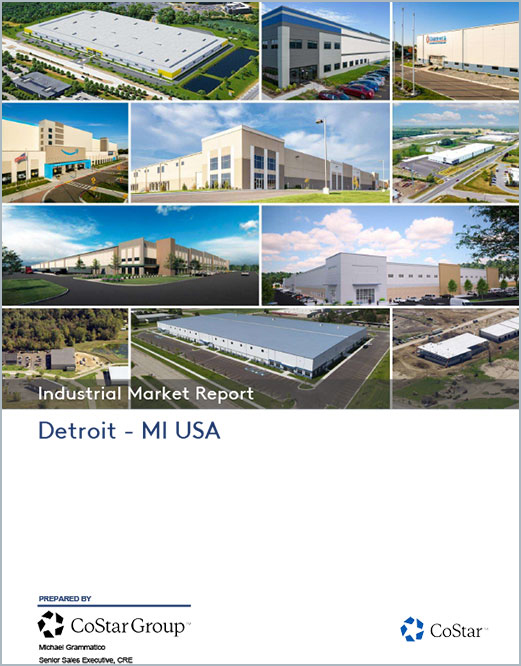
Prepared by Michael Grammatico, Senior Sales Executive, CoStar Group, Inc.
As the fourth quarter of 2025 moves along, industrial property owners across Detroit are contending with a stretch of weak tenant demand that's pushing vacancies towards late-2015 highs.
Detroit's industrial space markets hit a significant speed bump in the first quarter, as tenant move-outs outpaced move-ins by around -2.7 million SF. That was the weakest quarterly tally since the end of 2009 and dragged the trailing 12-month net absorption total to -4.1 million SF. Some of the largest industrial nodes to see large blocks of space returned to landlords were Detroit West (-858,000 SF) and Livonia (-766,000 SF).
On the supply side, developers were busy in the past year completing projects totaling 1.2 million SF. The lion's share of activity was in the Auburn Hills, Pontiac & Rochester submarket, where 1.2 million SF of new supply was added to the area's inventory.
The stark supply-demand imbalance has weighed on the market, guiding the average vacancy rate to 5.0% from 4.2% last year. Despite the move higher, Detroit's vacancy reading remains far below the U.S. average of 7.5%. In fact, the national vacancy measure has been higher than Detroit's by at least 220 basis points since the first quarter of 2024. The gap between the two is expected to remain elevated through 2026.
Detroit's industrial market should stabilize early next year, owing to a bounce back in tenant demand and easing supply-side pressure. Preliminary estimates of new leasing activity show that deals totaling 7.9 million SF were signed in the first six months of the year. That was 64% higher than last year's figure and the highest first-half tally since 2023. Leasing commitments typically boost absorption measures six to nine months in the future when the tenants occupy the new space.
Historically, Detroit has not been susceptible to wild gyrations in rental performance. While many industrial markets across the country saw a pandemic-induced spike in asking rents, Detroit's rent growth peaked at 7.2% in early 2022, up from 5.1% at the end of 2019. While rent growth has cooled considerably to 2.7% in July, it remains above the national benchmark of 1.4%.
Backstopped by improving space demand and a gradually depleting pipeline, the Base Case forecast anticipates rent growth to hover around current levels for the rest of the year.