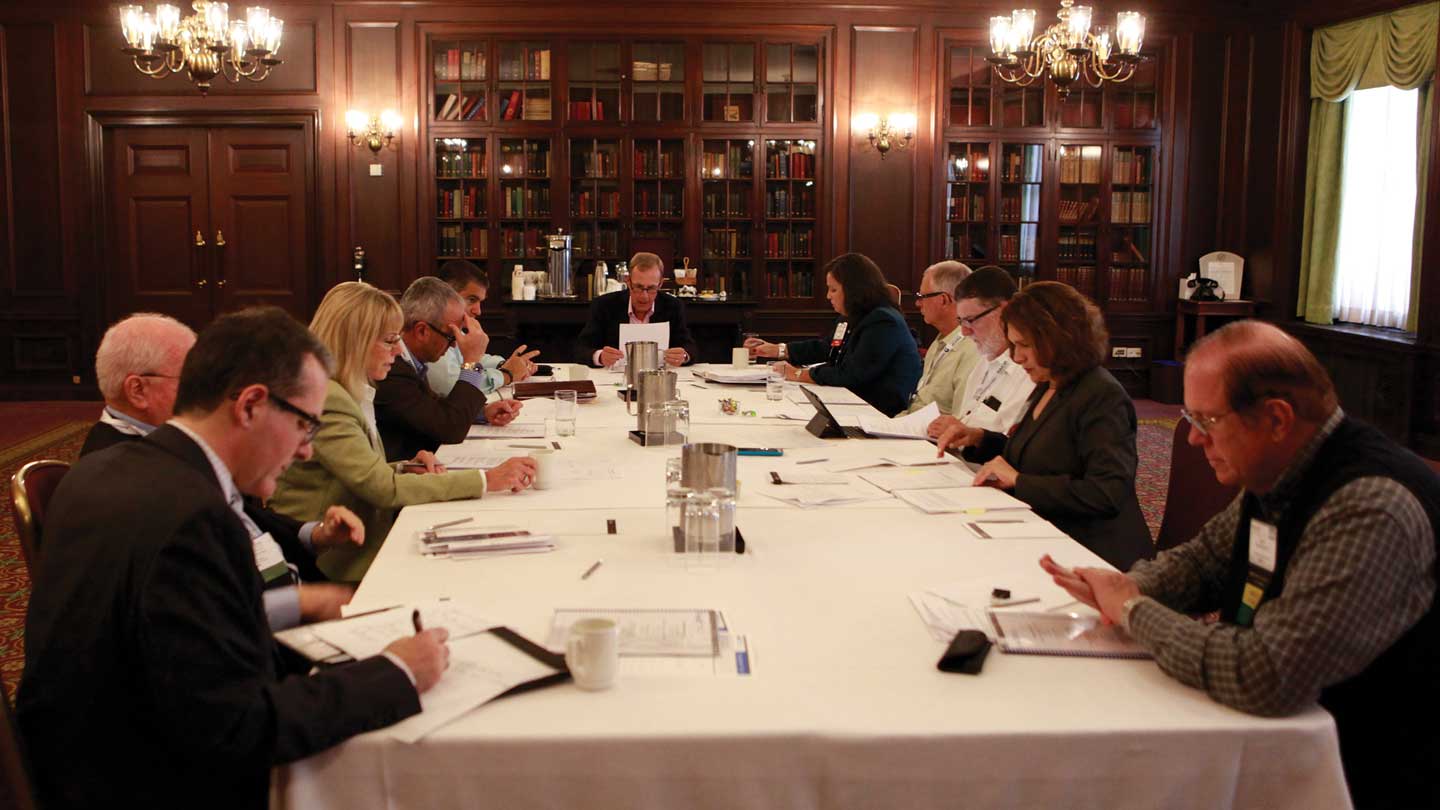
The Foundation’s legacy of research and thought leadership continues to shape the future of commercial real estate.
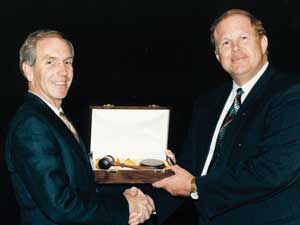
1996 NAIOP Chair Thomas Senkbeil (left) passes the gavel to 1997 Chair Ronald Rayevich. Both would be founding Research Foundation Governors, with Rayevich serving as the Foundation's first chair. NAIOP Archives
The NAIOP Research Foundation, which marked its 25th anniversary in 2025, was established with the stated purpose of supporting “individuals and organizations engaged in real estate development, investment and operations with the information they need to be successful.” While the Foundation has evolved over the years, it continues to deliver on its purpose with regular and timely research reports on trends affecting commercial real estate (CRE).
In addition to topical reports on emerging trends, the Foundation’s publications include analyses of the economic contributions of CRE to the U.S. and Canadian economies, office and industrial space demand forecasts, the NAIOP Market Monitor and the CRE Sentiment Index. The Foundation hosts regular meetings for Research Foundation Governors and Visionaries, as well as thought leadership summits on issues of importance to the industry. It also maintains a Distinguished Fellows program for university faculty who are engaged in research related to CRE and hosts meetings of the National Research Directors group — composed of professional CRE researchers — to discuss trends affecting the industry (see page 96). The Foundation’s research and activities are funded by annual contributions from NAIOP and individual NAIOP members and by the proceeds of an endowment funded by contributions from NAIOP Research Foundation Governors, who have each pledged $25,000 to the Foundation.
Formation and Early Years
The NAIOP Research Foundation came about at a time when NAIOP volunteers and staff were expressing growing interest in publishing research on emerging topics in CRE. As Shirley Maloney, the Foundation’s first executive director, recalled, prior to the Foundation, NAIOP did not have a funding mechanism to pursue research unless it could be easily turned into a for-sale publication. The Industry Trends Task Force, which had already been established to identify important trends for NAIOP to study, could suggest ideas for future research, but NAIOP had only limited resources to pursue them. Ronald Rayevich, who served as a member of NAIOP’s board of directors from 1991 to 2001 and had helped to start the National Forums program, remembered that the Forums would also generate ideas for topics to study.
Maloney said Rayevich was instrumental in coming up with the idea for the Foundation and recruiting other volunteers to help with its initial organization and fundraising. As NAIOP approached its 35th anniversary, “Ron Rayevich was telling us that we have these members who have been members since the beginning, and they have done really well in the CRE industry and are probably open to giving back,” Maloney recalled. Rayevich indicated that he, Ronnie Duncan and Dana Rowan constituted a committee of three NAIOP volunteers to organize and fundraise for a new foundation.
Thomas Bisacquino, then president (and later CEO) of NAIOP, at the Panama Canal in 2012. NAIOP Archives
At the October 1999 board of directors meeting, Rayevich proposed that NAIOP study the feasibility of using a portion of its operating surplus to fund a foundation that would “support research of generally non-political topics of importance to NAIOP and its membership.” At the February 2000 board meeting, Marty Irving proposed a motion that was approved to seed the Foundation with a $100,000 contribution from NAIOP. That summer, Maloney, Rayevich and Thomas Bisacquino, then-president of NAIOP, led conference calls with Duncan, Irving, Rowan and Anne Evans Estabrook, NAIOP’s chair-elect, to create a business plan for the Foundation and work on its incorporation. The NAIOP Research Foundation was officially established Aug. 30, 2000, and held its first meeting at NAIOP’s annual conference in Orlando that October. Rayevich served as its first chair (a position he retained through 2008), and Estabrook, Duncan, Bisacquino, Rowan and Irving comprised the remaining original Trustees.
One of the things that stands out in Rayevich’s memories about the Foundation’s first year was the effort to fund an endowment for future research. The Foundation’s Trustees set a goal to recruit as many Governors as possible by Sept. 1, 2001, all of whom would be recognized as Founding Governors of the Research Foundation. Despite the dot-com recession playing out at the time, the Foundation was successful in recruiting 10 Founding Governors (see below). According to Maloney, the Governors program was initially conceived as a way for senior NAIOP members to give back to the industry and remain engaged with the association by helping to shape the Foundation’s research agenda.

The Research Foundation Governors meeting in 2009. NAIOP Archives
Shortly thereafter, the nation was rocked by the events of 9/11. Although the Foundation’s main purpose was to support research on topics related to CRE, NAIOP turned to it as a vehicle to raise donations for a relief fund. The fund ultimately raised and donated more than $175,000 to charities supporting the families of the victims and the communities impacted by the attacks.
Another of the Foundation’s first initiatives was establishing a Distinguished Fellows program to serve as a bridge between university real estate degree programs, academic researchers and the CRE industry. According to Maloney, NAIOP also began offering discounted conference registration to students around this time so that Distinguished Fellows could bring students with them. In October 2001, the Foundation established a fund to cover the cost of the Fellows’ travel to NAIOP conferences, and the first class of Distinguished Fellows was admitted in 2002. That same year saw the Foundation’s first published report, “Financing Regional Infrastructure,” by Robert Schmidt, Ph.D.
Governors Reflect on Joining the Foundation
Douglas Howe came on board as a Governor in 2005 after becoming aware of the Foundation through his involvement on the Industry Trends Task Force. “I saw the immediate benefit of opportunities to gain additional knowledge and experience through involvement in the Research Foundation,” he said. “I think the Research Foundation elevated NAIOP to the next level as a premier national, or you could even say international, real estate association. It really put us on the map as something special and world class. … It’s all about increasing and enhancing the membership benefits through providing additional learning and knowledge.”
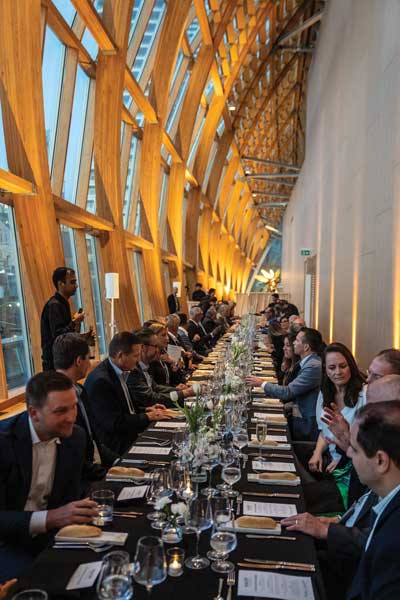
Gathering at the most recent Governors dinner in Toronto in 2025. Photo by Stephen Brashear
Bill Hunt noticed the projects and reports originating from the Research Foundation while he was serving on NAIOP’s board of directors. He elected to become a Governor in 2011 in recognition of all the Foundation research he had utilized in his career and to acknowledge the work of the Founding Governors in setting up the organization. “I thought it was my time to be part of the process as well as the solution, to give back and to keep the organization moving forward,” he said.
In being part of the Foundation, “you’re around people who have similar passion for the industry that you do,” Hunt said. “And that’s a great thing. Everyone cares a lot and is dedicated to doing what they can to support those within the real estate industry to get better.”
Jean Kane, 2025 chair of the Research Foundation, became a Governor in 2013. “My initial introduction to the program was when I was serving on the NAIOP executive committee. I had a very close lens on the activities of the Research Foundation and the Governors. When I looked at the composition of the Governors at that time, it was made up of people who were well respected, who had been in the industry a long time, and who had navigated a lot of different business cycles. I saw an opportunity to gain some wisdom from connecting with them, which I absolutely did.”
Skip Kalb said he became a Research Foundation Governor in 2015 because he was approaching the end of his “active employment career and I wanted to give back to the industry that I love — the industry that allowed me to combine my vocation with
my avocation.”
Growth and Evolution
The growth of the Foundation’s endowment provided it with a reliable funding source for research, allowing the Foundation to gradually increase the pace of its publications and continue its activities through the Great Recession. Over time, it widened the scope of its research and related activities.
When prominent NAIOP volunteer and Foundation Governor Boyd Stofer passed away in 2011, the Foundation raised an endowment in his honor that provided for the Boyd Stofer Distinguished Fellowship and established a permanent source of funding for the NAIOP Distinguished Fellows program. Another notable initiative around this period was an international trip that the Foundation coordinated for Governors to visit the Panama Canal in 2012.
The primary difference Hunt has noticed between the time he joined the Foundation and its current iteration is its scale. “It’s gotten much, much bigger. It has evolved and grown over time, and it’s exciting to see new people entering,” he said.

Douglas Howe gives a toast at the Governors dinner in Seattle in 2023. Photo by Stephen Brashear
Hunt also noted that through the years, the release of Foundation research reports has gotten timelier and more relevant for members. “There’s an understanding that these projects need to be done quickly,” he said. He highlighted the applicability of the Foundation’s research, such as 2022’s “New Uses for Office Buildings” and 2025’s “Succession Planning for Commercial Real Estate Firms.”
“The reports are more and more focused on current trends and therefore more value added to the developers and less theoretical content,” he added.
Kane also commented on the Foundation’s ability to fund the publication of more frequent research reports, which she believes has broadened the Foundation’s impact. “I love that our research focuses on case studies and insights that our members can implement and use today,” she said. One report that stood out to her was 2020’s “The Evolution of the Warehouse,” which examined advanced trends in warehouse technology. “The topics and themes — whether it’s about real estate, succession planning, adaptive reuse — they always provide practical, real-time information, not too much theoretical. And I also appreciate that we engage with multigenerational members, our Distinguished Fellows, and people in diverse sectors and regions of North America. The topics are percolating up from our actual members, which is so very important.”
Thinking back to when he joined as a Governor in 2005, Howe said the Foundation “was small at the time, but we were very focused on growing the membership. We created a goal of reaching 100 Governors, and we made a concerted effort to build awareness of the Research Foundation within NAIOP.” Twenty years later, attainment of that goal is in reach. “We were hoping it would happen a little quicker,” Howe said, “but when it does, I think it will create some huge opportunities to fund and enhance the Research Foundation even further.”
Creation of the Visionaries Program
The establishment of the Visionaries Program, which provides opportunities for industry leaders who are 40 and younger to participate in the Foundation, marked a significant evolution in the Foundation’s membership. Foundation Governor Barbara Schaefer McDuffie played a key role in advocating for the creation of the Visionaries program to bring younger voices into the organization. McDuffie also helped to establish the Foundation’s mentorship program, which provides Visionaries with opportunities to meet and learn from several Governors, allowing them to benefit from the accumulated experiences of individuals who have reached the pinnacle of their careers. The participation of the Visionaries has also helped the Foundation identify emerging trends and projects that will resonate with midcareer professionals. The Foundation admitted the first class of Visionaries in 2017.
Governors who have participated in mentoring the Visionaries speak highly of the program. “Like any other scenario with younger people, you can teach them and they can teach you as well,” Hunt said. “My generation has a good deal of experience to offer, but these developing leaders are the ones currently on the front lines of projects. They’re working for companies doing many, many transactions.”
Kane concurred: “I love to lean in and connect with these rising professional leaders because they’re a different generation offering a fresh perspective, and what they’re experiencing in real estate is different from when I started.”
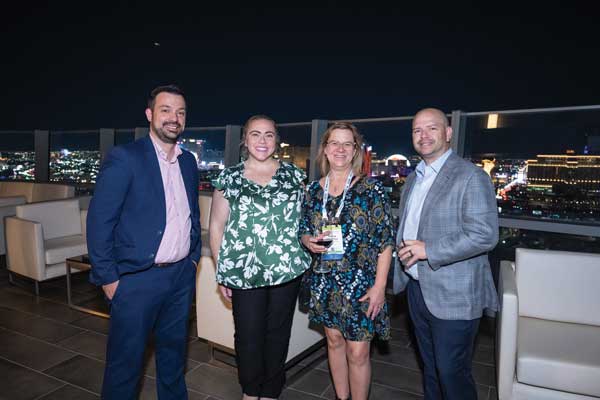
Research Foundation Governors reception in Las Vegas in 2024. Photo by Adrienne Angelo
Kalb cited the broader impact the program can have on the future of CRE as a reason that he has volunteered to mentor about a dozen Visionaries over the years: “If I could help the next generation in any way, it doesn’t just help them; it helps the corporate real estate industry, which helps all of us.”
Since the program’s beginning, 12 Foundation Visionaries have gone on to become Foundation Governors, and several now participate in mentoring current Visionaries.
Looking to the Future
Hunt continues to find his involvement in the Research Foundation and Governors program motivating. “Sometimes you get a sense of complacency, and then you go and meet with your peers — national peers — and you realize all the great things they’re doing in real estate and in their communities. It gives you a burst of energy. It makes you go back to your company and say, ‘Let’s continue on and do the right things. Let’s learn from others in the industry and grow as much as we can.’”
Kane said her ongoing involvement in the Research Foundation, and particularly her exposure to how a new generation of Governors and Visionaries is leading through unique challenges, “has reinforced my optimism for our industry and our ability to evolve, adapt and thrive. I think there’s a lot of promise ahead. The next generation of NAIOP leaders has some impressive talent.”
Kalb feels the Foundation is well positioned to continue providing cutting-edge research as the industry navigates a constantly shifting landscape, driven in large part by the emergence of AI. “The industry is undergoing major changes right now. It is evolving, and we just have to keep up with it,” he said. “With AI and the blending of the asset classes, the industry is becoming more complex than it has ever been, which I think makes the Research Foundation all that much more important.”
Kalb added: “What are the three words associated with real estate? Location, location, location. I’m saying now, side by side with that, we need information, information, information before we can even think about location.”
Shawn Moura, Ph.D., is vice president for the NAIOP Research Foundation. Jonathan Rollins is managing editor of publications for NAIOP.
Founding Governors of the NAIOP Research FoundationRichard Cannon |
Foundation Facts and FiguresNumber of Reports Published by the Research Foundation: 141 |
Timeline2000 NAIOP Research Foundation Established |