Developers are searching for strategies to help protect their return on investment.
For decades, parking structures were treated as the throwaway line in a pro forma — necessary, unglamorous and rarely questioned. That thinking no longer works.
As cities densify and mobility shifts, parking is becoming one of the most strategic pieces of real estate on a site. Done wrong, it’s a sunk cost. Done right, it drives frontage, obtains lease premiums and provides future-proof value.
The rise of electric vehicles, the push for placemaking and the demand for mixed-use connectivity are rewriting the rules. A garage is no longer just a container for cars — it’s an urban asset that shapes experience, revenue and resilience.
For developers, the mandate is clear: Build parking that performs today and adapts for tomorrow.
Increasing Capacity for EVs
As governments tighten emissions regulations, EV adoption continues to accelerate. In 2023, EVs represented more than 7% of new vehicle sales in the U.S., with projections estimating 30% to 40% by 2030. California’s Green Building Standards Code already requires a significant share of new parking to be EV capable, and other states are following.
Installing EV capacity during construction is substantially cheaper than retrofitting. One study found EV-ready construction reduces costs by 75% compared with retrofit installations. Another concluded that chargers installed in new construction are up to four times less expensive than retrofits. Advanced systems with smart load management can run as high as $10,000 per stall. Likewise, it is far cheaper to size future demand for conduits, panels and electrical capacity up-front rather than having to dig up concrete later.
Long-term demand also supports scalable investment. Federal data from the U.S. Department of Transportation’s 2022 National Household Travel Survey shows that personal vehicles are parked roughly 95% of the time, with the average vehicle in use for just over an hour per day. These patterns guide how municipalities and planners model parking needs. Even as mobility evolves, long-duration vehicle storage is essential, so flexible design, electrification readiness and scalable capacity are critical to long-term performance.
Best practices include:
- Installing spare conduit and oversized panels to allow scalable charging growth.
- Using load management systems to reduce peak demand charges.
- Zoning stalls for both short-term turnover and long-term residential charging.
Leveraging Rooftop Spaces for Amenities
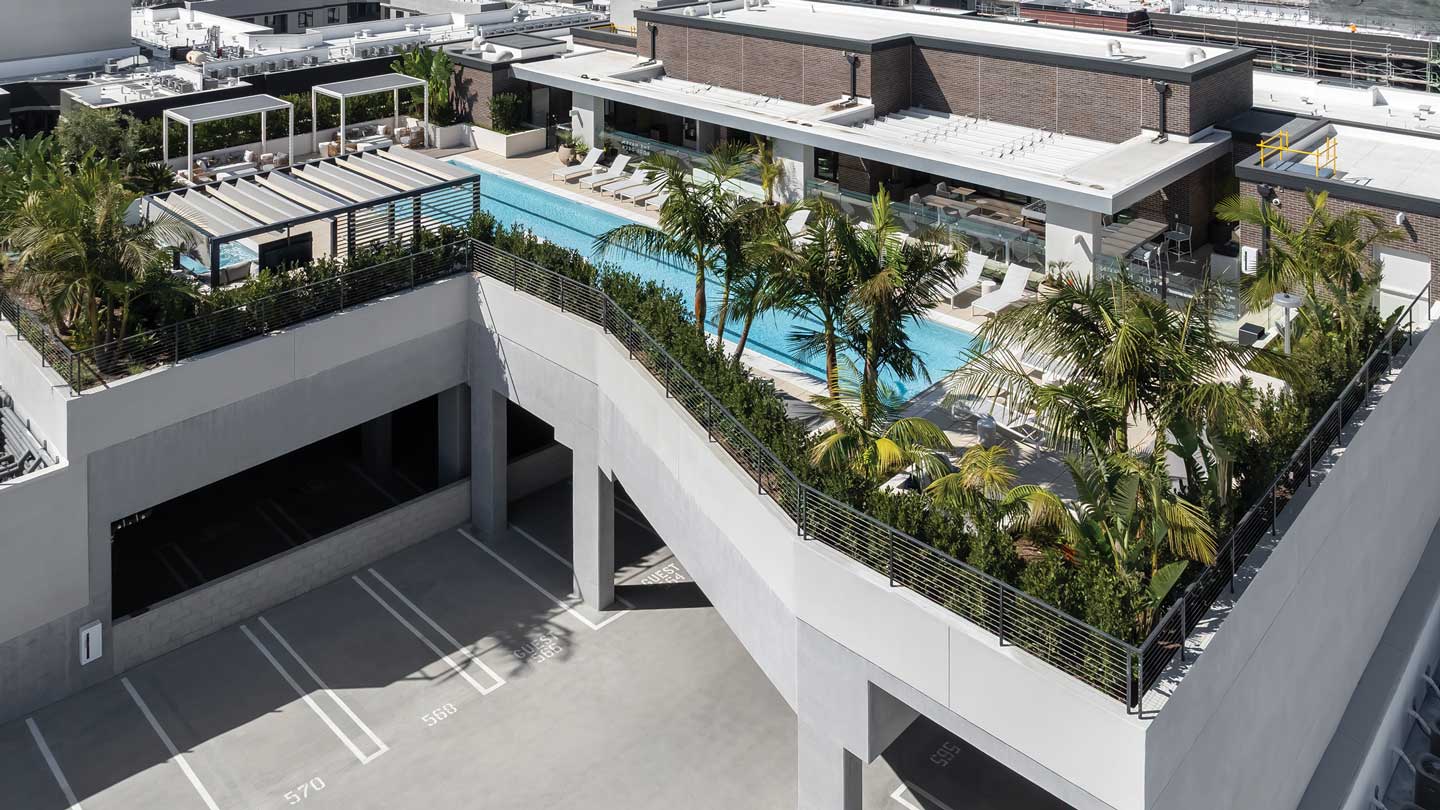
Parking structures are increasingly viewed as more than storage for cars. Garage rooftops are being reclaimed for pools, gardens, fitness centers, event spaces and other amenities that enhance tenant experience while unlocking land value.
Building such spaces can be costly. Rooftop amenities typically range from $30 to $50 per square foot, depending on utilities and structural requirements. The structures must be reinforced to support water loads, gatherings or equipment. Early reliance on tested detailing — and a careful balance between the amenity above and the parking structure below — safeguards revenue, protects lease premiums and ensures the rooftop performs as a long-term asset.
Shifting recreation to a parking structure’s roof also reclaims the ground plane for revenue-generating frontage, retail and rentable square footage.
Three Approaches to Future-proofing
The following case examples showcase three different approaches to future-proofing parking structures.
The Row at Red Hill (Santa Ana, California)
Challenge: A 14.5-acre mixed-use development designed for Greystar required four garages to support 1,100 residential units and retail tenants, with EV infrastructure and resident amenities integrated across the site.
Strategy: AO designed 247 EV-ready stalls, with a total of 2,458 parking stalls and oversized electrical systems for scalability. Rooftop decks with pools, gardens and lounges were added to the garages, creating open, view-rich terraces.
Result: Vertical circulation was transformed into vertical opportunity. AO turned what most see as stairs and elevations into usable, profitable space. Secure access, natural ventilation, privacy screens and acoustics strategies balanced livability with safety for residents.
ROI: By shifting the amenity decks upward, the development preserved ground-level retail frontage and paseos. Rooftop pools became a leasing differentiator, while EV readiness positioned the property for future demand. Rather than adding land, AO’s approach made the land do more — amenity in the sky, income on the street.
Culver City Parking Structure (Culver City, California)
Challenge: A city-partnered commercial project adjacent to residential neighborhoods required sensitive design, public buy-in and multimodal integration. The development introduces 13,700 square feet of luxury retail and culinary offerings, creating a curated public market within a compact, walkable block.
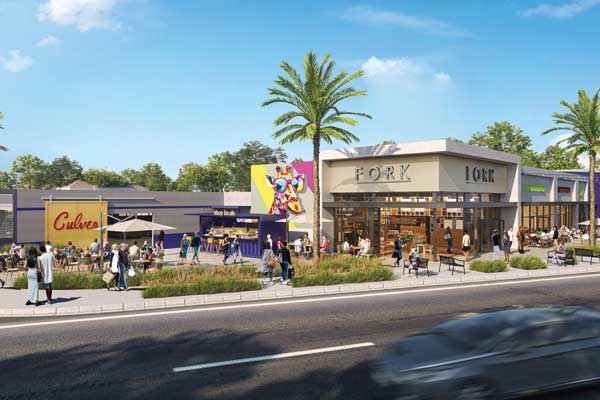
A structural revision minimized visual impact of a two-story, 122-stall public parking structure at Culver Public Market. Courtesy of AO
Strategy: AO optimized the design of a two-story, 122-stall public parking structure to meet project goals while controlling costs and maintaining community support. By carefully adjusting the height and layout, the design preserved full parking capacity while reducing unnecessary structural material. Thoughtful space planning for standard, accessible and EV stalls avoided excess square footage, and the use of exposed masonry and wood-look materials delivered a visually appealing finish without expensive cladding. Mobility integration included bus stops, ADA-accessible stalls, bike parking (32 stalls total), and a dedicated ride-share pick-up/drop-off zone.
Result: Open facades balanced security with daylight and visibility, while murals and public art enhanced the pedestrian realm. The garage delivered 23 EV-capable stalls and four active chargers, with backbone infrastructure for more.
ROI: The structural revision reduced costs, minimized visual impact and streamlined construction. By prioritizing flexible curb space and sizing parking to actual demand, the project created leaner infrastructure with long-term adaptability.
The Boardwalk at Bricktown (Oklahoma City, Oklahoma)
Challenge: Surface parking limits activation of the boardwalk area, constraining opportunities for residential, hotel, retail and entertainment uses.
Strategy: Plan a multilevel podium with stacked parking, incorporating adaptable structural grids, clear circulation and EV-ready electrical capacity. Free up perimeter edges for shops, restaurants and public space, designing the garage for long-term flexibility and evolving mobility patterns.
Result (planned): The design intends to transform underutilized land into a vibrant, pedestrian-friendly boardwalk. Structural adaptability, with podium columns and spans arranged to support rooftop amenities, expanded retail or mixed-use functions while continuing to provide parking below, will allow the garage to evolve alongside changing demand and mobility patterns.
ROI (projected): Stacking parking and activating the perimeter is expected to unlock leasable frontage, enhance tenant experience and create long-term revenue potential. Flexibility and EV-ready systems are planned to ensure the asset remains adaptable as mobility and market demands evolve.
Cost Breakdown and ROI
While the up-front costs of future-proofing can be significant, the long-term payoffs are measurable. Projects like the Culver City garage, with 23 EV-capable stalls and backbone infrastructure for additional chargers, and The Boardwalk at Bricktown, with over 60,000 square feet of rooftop and more than 163,000 square feet of retail space, illustrate how flexible design and future-ready systems increase functionality and revenue potential over time. In new construction, EV-ready infrastructure typically adds $1,500 to $3,000 per stall. This includes conduit, panel capacity and electrical planning without chargers. In comparison, retrofitting a legacy garage can exceed $5,000 per space, including demolition, electrical upgrades and operational disruption.
Future-ready measures include oversizing electrical rooms and feeders, prerouting conduit to all stalls or parking modules, and integrating automatic load management systems. Managed Level 2 charging with load management and strategic timing allows garages to serve significantly more EVs than nominal capacity suggests.
Key ROI drivers include:
- Increased demand: EV-ready structures and rooftop amenities command higher rents and broader tenant appeal.
- Lower operating costs: Solar-ready roofs, LED lighting and efficient systems reduce lifetime costs.
- Government incentives: Local agencies offer rebates and tax breaks for EV chargers, solar panels and green systems.
Strategic Considerations
Future-proofing isn’t free. Rooftop amenities demand stronger structures, and scalable EV systems require coordination with utilities and evolving codes. EV adoption continues to grow unevenly, and transportation forecasts can be uncertain. Designing scalable, flexible parking infrastructure ensures garages support electrification as demand evolves rather than relying on fixed assumptions.
The challenge for developers isn’t whether to future-proof parking structures but how to do it without eroding returns. EV-ready infrastructure, rooftop amenities and adaptive design separate assets that lease fast and hold value from those that fall behind.
The real play is timing: Invest in the backbone (conduits, panels, structural detailing) before construction when it’s cheapest and least disruptive. Layer in flexibility where demand is uncertain, and scale only when returns justify it.
When done right, future-proofing isn’t added cost; it’s a value multiplier. It drives rents, accelerates absorption, and keeps properties compliant and marketable for decades.
Jason Rupp is a partner at architectural firm AO.
Best Practices for Developers
|