Sacramento’s Aggie Square followed a model that balances real estate risk with public-interest goals.
In the evolving world of commercial real estate, few models have captured the attention of developers, universities and civic leaders as powerfully as the rise of innovation districts: mixed-use, research-driven urban hubs clustered around anchor institutions.
In May 2025, the University of California, Davis and its development partner, Wexford Science & Technology, LLC, alongside the city of Sacramento and the Greater Sacramento Economic Council (GSEC), celebrated completion of the first phase of Aggie Square. The development journey of the $1.1 billion innovation district offers a compelling case study and instructive lessons in vision, partnership, compromise and community engagement.
Original Vision and Early Context
Aggie Square’s origins trace back to late 2017, when Darrell Steinberg, then mayor of Sacramento, and UC Davis Chancellor Gary S. May convened a joint exploratory working group to assess the feasibility of a university-anchored innovation district in the city. The group was charged with evaluating potential sites, transportation and infrastructure needs, funding pathways, and a framework for integrating academic research, private sector activity and community benefits.
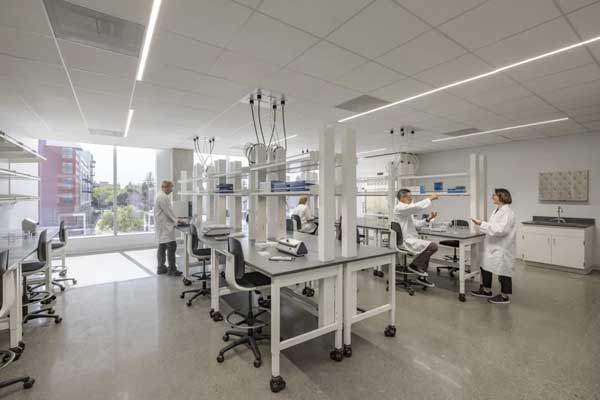
Aggie Square’s research buildings provide state-of-the-art laboratory facilities for life sciences, technology and engineering. Courtesy of Wexford Science & Technology
Site selection was guided by mission alignment rather than land speculation. UC Davis evaluated four potential locations in Sacramento against a defined set of criteria, including the ability to advance the university’s research and public-service mission, catalyze regional economic growth, foster community health and connection, and strengthen transportation links between Sacramento and the Davis campus. Additional factors such as infrastructure readiness, housing proximity and development feasibility were also assessed.
Ultimately, the UC Davis Sacramento campus emerged as the strongest candidate. The site, located 7 miles east of downtown and adjacent to UC Davis Health, offered immediate access to academic and clinical assets, existing infrastructure and transit connectivity. Importantly, the university already owned the land. This eliminated acquisition costs and allowed project resources to be directed toward programmatic, community and infrastructure investments rather than land procurement.
“From the beginning, we saw Aggie Square as an opportunity to bring UC Davis’ research excellence into closer alignment with industry and community,” May said. “The goal was to create a space where ideas, talent and partnerships could translate into meaningful impact for the region.”
By 2018, national and regional market trends were reinforcing the viability of this approach. Demand for life science and research-driven real estate was accelerating, shaped by demographic pressures, advances in biomedical innovation and growing space requirements for translational research facilities. Across the country, developers and universities were recognizing that well-planned, lab-capable environments adjacent to major research institutions were commanding a premium and fueling new models of research commercialization and economic development.
For Sacramento — long anchored by government, health care and service sectors — the proposed district represented a chance to broaden the region’s economic base. Workforce development pipelines, community-accessible programming and public-benefit commitments were built into the early vision to ensure the district would serve multiple constituencies.
“Aggie Square is an important investment in Sacramento’s economic future. It helps us grow high-quality jobs, attract new industries and strengthen our role as a center for innovation while making sure that growth benefits the broader community,” Mayor Kevin McCarty said. “From its earliest planning stages, Aggie Square was conceived not merely as a facilities expansion but as a regional catalyst aimed at delivering academic, economic and community value. The project was designed to position Sacramento more competitively within a national landscape increasingly shaped by innovation-focused development.”
Definition of Program
This design articulated a multibuilding Phase 1 plan spanning roughly 8 acres of what ultimately will be a 25-acre footprint. Desired components included:
- An office/classroom building dedicated to lifelong learning and workforce skills training.
- Two research buildings offering state-of-the-art laboratory facilities for life sciences, technology and engineering.
- A mixed-use building with ground-floor “storefront” space for community groups and university-affiliated projects, student and affiliate housing, and retail, all connected to an outdoor plaza focusing on food and health.
- A public square providing open space for community gatherings, public events and spontaneous interaction among researchers, students, community members and entrepreneurs.
- A five-story parking structure.
UC Davis selected Wexford Science & Technology as master developer for Aggie Square Phase 1 in January 2020, concluding a competitive process just weeks before the onset of the COVID-19 pandemic.

Courtesy of Wexford Science & Technology
The pandemic reinforced the value of building flexibility into Phase 1. While the overall program remained cohesive, the partners adjusted sequencing to better align with leasing conditions, pausing construction of the 100 Aggie Square lab building until preleasing milestones are met across the remaining space. When it moves forward, the building will be delivered as a flexible, mirror-image companion to the 200 Aggie Square East tower.
Building Public Support
As planning progressed, UC Davis, Wexford and the city of Sacramento formalized a set of agreements to ensure Aggie Square’s benefits extended beyond the project’s boundaries. These documents established commitments around the core components of the project’s public-facing framework, including workforce development, affordable housing, transportation improvements and long-term community access.
The first milestone was a community workforce training agreement (CWTA) executed in April 2021 with Whiting-Turner, the Aggie Square construction contractor, and regional labor partners. The agreement outlines local hiring priorities, apprenticeships and preapprenticeships, workforce reporting requirements and labor standards intended to connect Sacramento residents to career-track opportunities in the construction trades. By codifying these expectations, the CWTA ensured Aggie Square’s economic impact would begin during the construction phase rather than at completion.

Muralists were commissioned to create installations throughout Aggie Square, including on the facade of a five-story parking garage. Courtesy of Wexford Science & Technology
A community benefits partnership agreement established a long-term strategy for inclusive growth. Negotiated among UC Davis, the city, Wexford and community representatives, the agreement covers affordable housing investment, youth
and workforce programs, small-business support, transportation and streetscape improvements, and community access to project spaces.
A third tool, the Enhanced Infrastructure Financing District (EIFD), a tax increment financing mechanism specific to California, serves as the project’s primary public-financing mechanism. By dedicating a portion of future property tax revenue to infrastructure improvements, the EIFD enables long-term investment in roads, utilities, open space and mobility enhancements that support both the district and surrounding neighborhoods.
Together, these agreements formed a shared framework intended to balance research and real estate goals with community priorities.
“Community needs and real estate goals do not have to be mutually exclusive,” said Travis Sheridan, Wexford’s chief community officer. “Engaging the community early allowed us to co-create a comprehensive community benefit strategy recognizing that the needs of the community will evolve over time. Innovation isn’t static, and neither are the lives that interact with Aggie Square. If innovation truly is a process to improve the human condition, then a broad swath of those humans should be involved in the process. Real estate is an enabler. Good real estate is a catalyst.”
Inclusive Design and Intentional Place-making
The design and planning of Aggie Square emphasized sustainability, climate resilience and an inclusive public realm. The research buildings incorporate high-efficiency heating and cooling, heat-recovery ventilation and water-saving systems that reduce consumption by up to 60% compared with typical laboratory facilities. The site’s landscape features native, drought-tolerant plantings, permeable surfaces and extensive shading to create comfortable pedestrian environments suited to Sacramento’s climate.
Architectural expression drew heavily from regional materials and local partnerships. Led by ZGF Architects, the design team integrated Sacramento’s aesthetic character through a glass facade system fabricated by Bagatelos Architectural Glass Systems, a regional firm that also contributed to workforce apprenticeship goals established in the community agreements. To acknowledge the site’s history as a former fairground, the buildings incorporate a custom brick palette developed with local manufacturer H.C. Muddox. These elements include subtle moments of place-specific identity, such as a brick inlay referencing the University of California motto, Fiat Lux (“Let there be light”).
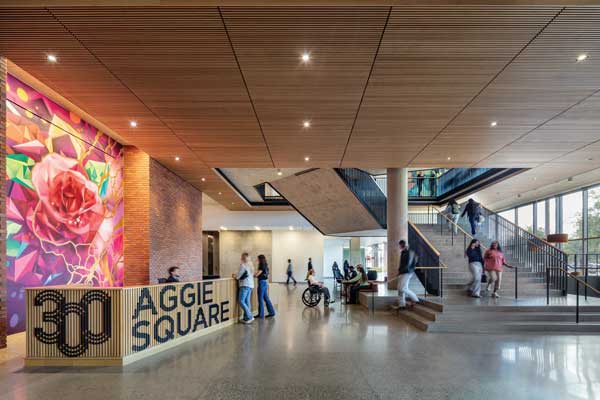
Researchers, faculty and staff began moving into 200 and 300 Aggie Square in February 2025. Magda Biernat; Courtesy of Wexford/UC Davis
To embed local culture into the district’s public spaces, Wexford and UC Davis collaborated with Sacramento’s Office of Arts and Culture on a competitive process to commission local artists. Four muralists were selected to create installations across key interior and exterior locations, including building entrances, shared research and teaching spaces, and a five-story garage facade. These artworks provide visual markers that connect the project to its surrounding neighborhoods and reinforce its civic character.
Tenant Mix and Program Design
UC Davis is Aggie Square’s anchor tenant, with about 60% of the leased space (approximately 400,000 rentable square feet) dedicated to university research, teaching and innovation. This includes multiple university verticals, ranging from Aggie Commons and classrooms on the office side to a ground-plane biomedical engineering makerspace and veterinary genetics facility on the lab side.
Tenant occupancy at Aggie Square began ahead of the district’s formal inauguration. Researchers, faculty and staff started moving into 200 and 300 Aggie Square in February 2025, with additional university and industry tenants continuing to occupy space as tenant improvements are completed. Residential activation followed in June 2025, with medical and nursing students moving into the ANOVA Aggie Square apartments. The university’s allocated housing in that complex reached full occupancy upon opening. Additional research uses will come online in subsequent phases, including the UC Davis Veterinary Genetics Laboratory, which is scheduled to move into 400 Aggie Square in late 2026 or early 2027 following completion of specialized tenant improvements.
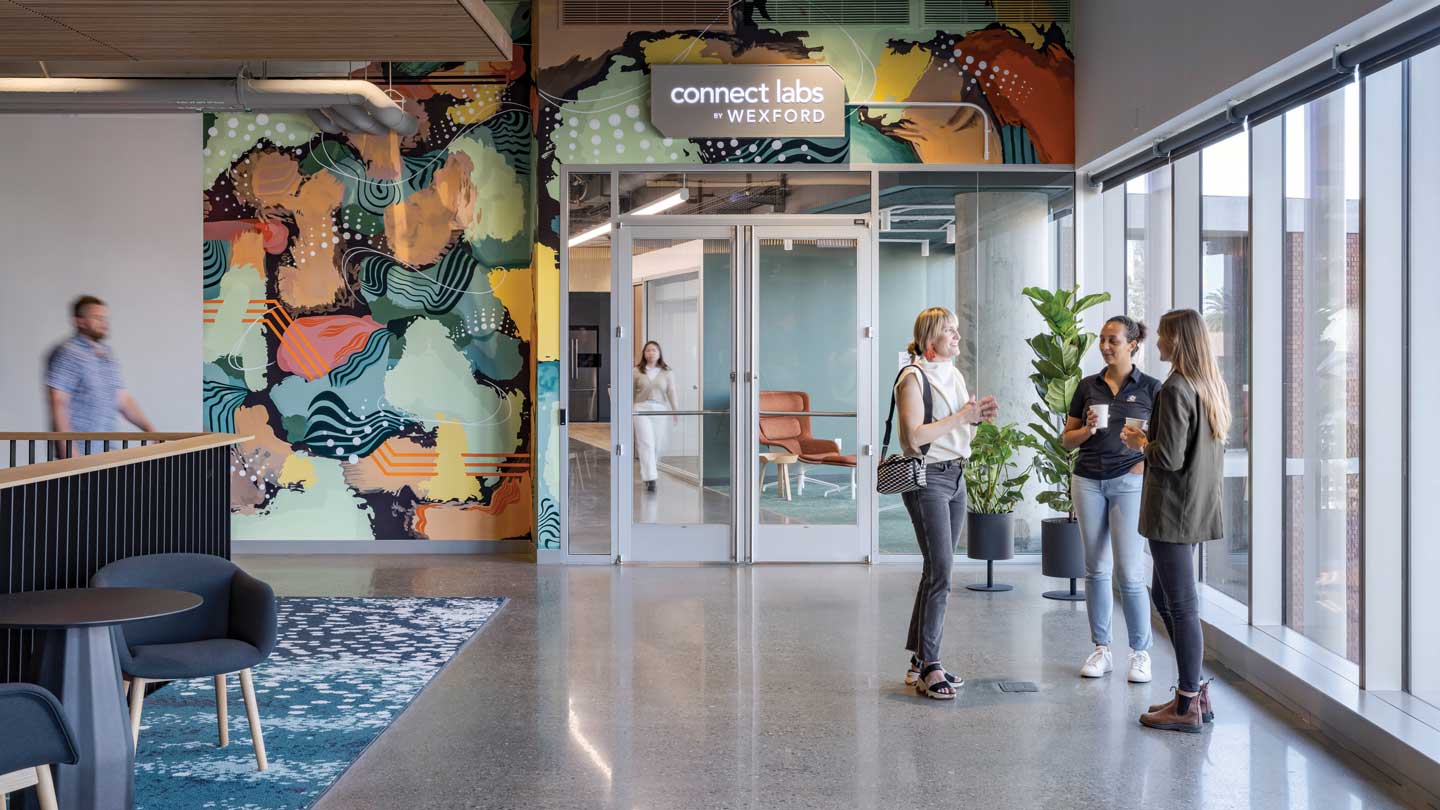
To facilitate the physical space side, the preliminary plan called for flexible, scale-in-place lab and office space, particularly through a facility known as Connect Labs by Wexford. The turnkey, furnished and pre-equipped lab/office solution is designed to lower barriers to entry for early stage and growth companies. This allows a derisked platform to scale in place at Aggie Square.
Beyond the physical space, Wexford brings what it refers to as the “software” of an innovation district — the programming, partnerships and people that animate the space and transform real estate into a functional “knowledge community.” For Aggie Square, this includes hiring a dedicated knowledge community director to curate programs, convene researchers and entrepreneurs, engage community organizations and ensure the district operates as a connected ecosystem rather than a collection of tenants.

UC Davis serves as Aggie Square’s anchor tenant, with about 60% of leased space so far dedicated to university research, teaching and innovation. Wayne Tilcock; Courtesy of UC Davis
Wexford’s model layers structured programming — inclusive of speaker series, startup showcases, industry roundtables, networking events, workforce development cohorts and community-facing activities — with informal activation. This ensures that students, faculty, innovators and neighborhood residents interact organically. The approach, which is central to Wexford’s national portfolio, made the district feel alive from its earliest days. This “software layer” is a critical complement to the bricks-and-mortar investment, helping ensure Aggie Square fulfills its mission as an accessible and inclusive hub of innovation for the region.
Early in the process, Wexford engaged Cushman & Wakefield as the real estate broker for the private industry pipeline. In partnership with the university and GSEC, Wexford and Cushman have connected with local, regional and international prospects to curate a strong mix of industry and academic research. To date, industry clients include med-tech startup Intellivasc, public policy consulting group Capitol Impact, ULI Sacramento and ag-tech organization GARBiC USA, among others.
From Planning to Reality: What’s Built and What’s Next
Aggie Square was formally inaugurated May 2, 2025, marking eight years of planning, partnership and development. Phase 1a delivers four major buildings (200, 300 and 400 Aggie Square, plus ANOVA residential) totaling approximately 800,000 square feet. This includes wet and dry laboratories, flexible workspaces, classrooms, community areas and a 1,550-stall parking structure. Phase 1b (100 Aggie Square’s second lab tower) will be delivered once preleasing thresholds are met.
Residential space, provided through ANOVA Aggie Square, is a joint venture between Wexford and its residential partner, GMH Communities. ANOVA includes 190 apartments (252 beds) with approximately 15,000 rentable square feet of podium commercial space. To date, the residential space is nearly 70% occupied with both university and market tenants. The housing is designed to support students, researchers and early stage companies while reinforcing the district’s live-learn-work-discover environment.
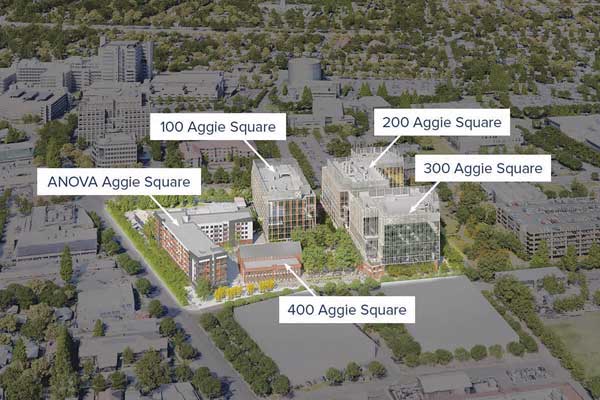
A site map showing Phase 1 of Aggie Square. Courtesy of Wexford Science & Technology
As the region’s largest economic engine, UC Davis generates nearly $9.57 billion to the Sacramento metro area and $13.2 billion to the state in annual economic impact while supporting 61,700 jobs. At full buildout, UC Davis estimates that Aggie Square will generate $1.92 billion in total regional output and $2.32 billion statewide, with construction supporting more than 12,000 jobs. Approximately 3,200 permanent positions are projected after full occupancy.
UC Davis Health has developed a long-range framework for the site, including a massing plan that anticipates up to an additional 1 million square feet of academic, research and office space beyond Phase 1. As early phases reach stabilization, the university and its partners intend to revisit this framework to align future development with market demand, institutional priorities and available funding. The timing and configuration of subsequent phases will therefore be phased and adaptive, allowing Aggie Square to evolve deliberately in response to research growth, industry interest and community needs rather than following a fixed development schedule.
Key Lessons and Takeaways
Throughout the multiyear planning and implementation of Aggie Square, several lessons emerged that are relevant for commercial real estate developers, institutional investors, universities and municipal stakeholders:
- Anchor strength plus market demand equal opportunity. Aggie Square advanced in part because UC Davis provided a strong academic and clinical foundation.
- Site matters, physically and contextually. Choosing a site adjacent to existing clinical and academic infrastructure created a compelling value proposition.
- Public-private partnership and structured community benefit commitments are essential. Integrating commitments such as affordable housing, workforce development and reinvestment mechanisms (the EIFD) into the deal structure helped make the project viable.
- Flexible, mixed-use design helps derisk long-term occupancy. By combining labs, offices, housing, classrooms and community space, Aggie Square avoids overdependence on a single real estate type.
- Early and sustained community engagement matters. Over 90 stakeholder meetings informed the community benefits partnership agreement.
- Sustainability and inclusive design are not optional. Energy- and water-efficient building systems, pedestrian-friendly public space, affordable housing and community access are increasingly viewed as baseline requirements.
- The most meaningful hardware requires thoughtful software. Activation requires programming, partnerships and ongoing curation.
Aggie Square demonstrates how a concept rooted in institutional strength, community priorities, market demand and collaborative governance can evolve into a built environment designed to share value. For developers and institutional investors, it offers a practical model for structuring public-private partnerships, integrating community benefits and creating mixed-use, resilient real estate. n
Claire Drummond is vice president of development and Sacramento market executive at Wexford Science & Technology, LLC. George Baxter is chief innovation and economic development officer, UC Davis. Leslie Fritzsche is economic investment manager for the city of Sacramento.
Aggie Square Fast Facts
|
|
Public-Private Partnership: Roles, Strengths and Structure A defining element of Aggie Square is its public-private partnership model. Rather than a traditional university expansion or a speculative private development, the district is structured around the complementary roles of three primary stakeholders: UC Davis, Wexford and the city of Sacramento. Each contributes assets that the others cannot, creating a shared platform for development, research and community impact. Responsibilities are distributed so that real estate risk is balanced with public-interest goals. Wexford provides market expertise, development capacity and delivery execution. UC Davis contributes its research enterprise, academic programs and institutional credibility. The city offers land-use authority, regulatory support, financing tools such as the Enhanced Infrastructure Financing District, and oversight to ensure alignment with community-benefit commitments. This structure serves as a potential template for other innovation districts. By aligning stakeholder strengths, sharing risk and embedding public benefit directly into the development framework, the partnership demonstrates how large-scale research districts can advance economic and civic goals simultaneously. |