Distributed energy is emerging as a practical risk management tool for owners and tenants alike.
Commercial real estate has long operated on the assumption that the grid will deliver needed power reliably and at a manageable cost. That assumption is weakening. The U.S. Department of Energy (DOE) warns blackout risks could rise by a factor of 100 by 2030 if firm capacity continues retiring faster than replacement resources come online. Outage incidents have increased 64% over the last decade, and nearly half of U.S. distribution infrastructure is at or past its intended service life.
For industrial, logistics, cold storage, food processing and life sciences businesses, these conditions translate directly into operational exposure. Downtime affects product integrity, production cycles, fulfillment, equipment health and customer commitments. As facilities become more electrified, automated and continuous, power stability and price certainty are increasingly central to tenant performance and, ultimately, asset value.
Energy risk has always mattered, but it rarely demanded attention. Now, rising volatility is forcing it to the center of the conversation. Stakeholders must consider several elements as part of the new energy risk stack for commercial real estate.
Reliability Risk
Outages are rising as aging infrastructure, extreme weather and growing loads strain distribution networks. Sensitivity differs by sector, but the overall trajectory is the same.
Cold storage is a clear example. Many frozen facilities are well insulated and can handle short power cuts or join demand response programs to reduce power use during peak times. Yet resilience isn’t uniform. As the Global Cold Chain Alliance has noted, longer and more complex outages have made it clear that “gone are the days of simply shutting the doors.” Facilities handling regulated food, pharmaceuticals or high-value perishables often have strict tolerances, and many older or smaller sites lack controls or backup systems needed for extended events.
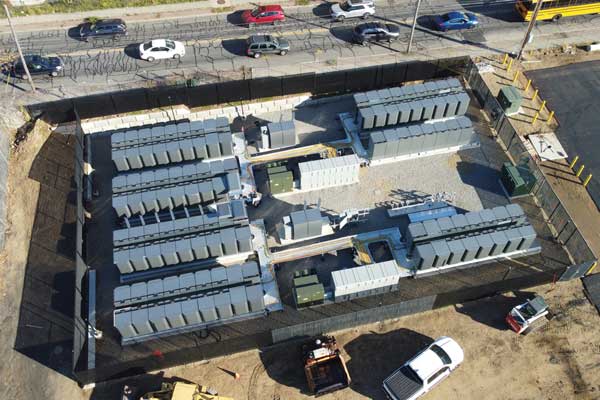
An aerial view of a fuel cell site. Courtesy of Bloom Energy Corporation
Food and beverage processors face batch losses and sanitation resets. Manufacturing tenants — particularly in pharmaceuticals, electronics and precision components — can incur costs of $100,000 to $150,000 per hour of downtime according to the DOE Energy Interruption Cost Estimate Calculator. Logistics operators, once a lower exposure segment, are now more sensitive as EV fleets, automation and refrigeration nodes push loads higher. In many modern warehouses, charging demand rivals building load, making outages a direct threat to throughput and mobility.
Across sectors, operational tolerance for power disruptions is tightening.
Power Price Risk
U.S. electricity prices have risen roughly 30% nationally since 2020, with sharper increases in coastal and high-demand markets, making energy a meaningful factor in leasing strategy. The U.S. Energy Information Administration (EIA) projects continued upward pressure driven by fuel costs, deferred maintenance and rising peak loads.
Alongside rising tariff prices, some more niche elements of power bills have seen substantial price increases. In the service area of the PJM Interconnection, the grid operator that oversees all or part of 13 states and Washington, D.C., capacity prices rose more than 800% in 2025. For commercial and industrial customers, this can represent an increase of up to 10% on their monthly utility bills.
Some large power users on legacy power purchase agreements or supply contracts may not feel the whole impact yet. That doesn’t mean they will avoid increased costs perpetually, however. Many commercial and industrial organizations locked in fixed rates when wholesale power prices were far lower. As their contracts expire, renewal pricing will reflect the constrained, higher-cost market shaped by data center growth, electrification and regional capacity shortages. The result will be sudden jumps in operating costs that many tenants didn’t plan for, creating downstream risk for landlords as renewal decisions shift and higher costs strain tenant credit.
Interconnection and Timing Risk
Utilities may be able to deliver the required load eventually, but likely not on the timelines industrial developments typically demand.
Electricity demand in the U.S. is rising for the first time in decades. The EIA projects commercial demand to grow 2.6% annually and industrial demand 2.1%, with data-center-driven load growing substantially faster. It is expected that certain geographic regions will see much higher demand growth. Grid operators across the PJM Interconnection, the Electric Reliability Council of Texas (ERCOT) and the California Independent System Operator (CAISO) service areas warn that capacity constraints are influencing siting decisions for industrial and logistics networks.
After years of stagnant load growth, a wave of high-density load applications is clogging utility interconnection queues, stretching engineering teams and prolonging timelines for distribution upgrades. Developers increasingly report 18- to 48-month service-expansion timelines, with transformer delays in some markets extending beyond two years.
Utilities aren’t ready for the coming demand surge, creating a material constraint on new development. For cold storage, robotics-heavy manufacturing, life sciences and fast-moving logistics, the power timeline is the project timeline. In these segments, interconnection risk is now development risk.
Distributed Energy as a Financial Hedge
Distributed energy — fuel cells, battery storage, solar-plus-storage and hybrid systems — is increasingly viewed as a risk mitigation tool rather than a sustainability enhancement. Distributed generation is installed on-site directly to reduce the reliance on power from the utility, allowing customers full control over their cost for power.
Distributed energy offers several advantages, including:
Cost stabilization: Long-term fixed pricing shields tenants and owners from tariff volatility and power purchase agreement rollover shocks.
Peak shavings: Many industries, such as manufacturing, textiles and EV fleet depots, have high “demand charges,” which are set by certain periods with high electricity usage. These high periods, even if infrequent, can increase costs for the entire year. On-site battery storage and fuel cells can directly reduce “peak” days, lowering demand charges.
Outage mitigation: Fuel cells and microgrids provide continuous, redundant power, keeping critical loads online during grid disturbances.
Timeline advantage: In many cases, systems can be deployed in six months, far faster than utility upgrades, increasing speed to operations either as a bridge-to-interconnection solution or permanent deployment.
Tenant differentiation: Power resilience and timeline to upgrades are becoming lease decision criteria for energy-intensive tenants.
The market is scaling rapidly. U.S. microgrid capacity was on track to reach 10 gigawatts in 2025, more than double 2022 levels. These systems are now mainstream infrastructure, with mature finance structures providing development capital so site owners can leverage capex-free energy-based or service-based deployment models.
While distributed energy offers clear advantages, it is not universally the right fit for every commercial or industrial owner. Stakeholders often raise concerns about the complexity of integrating new systems with existing operations, particularly when facilities already rely on long-term utility contracts or have limited on-site space for equipment. Others point to uncertainty around evolving regulatory frameworks, interconnection requirements and the potential for hidden costs in maintenance or performance guarantees. Selecting a deployment partner with proven technical expertise, transparent performance guarantees, and a track record of navigating regulatory and interconnection hurdles can significantly reduce these risks and help ensure distributed energy delivers its intended value.
For some, the perceived risk of adopting relatively new technologies, whether in terms of reliability, cybersecurity or alignment with corporate sustainability goals, can outweigh the appeal of capex-free deployment models.
Case Study: A Practical CRE Application
A 250,000-square-foot distribution center in Ohio had long operated with predictable energy costs until the power grid operator announced a massive shift. Capacity prices across the Midwest and Mid-Atlantic regions were set to rise by 1,000% from 2024 to 2025, driving an immediate 18% jump in the distribution center’s utility bills.
Dispatch Energy, a full-service distributed energy solutions provider, offered options to reduce the distribution center’s exposure to power and pricing volatility without disrupting operations.
One option was a natural gas-fueled fuel cell installed on-site and fully managed by Dispatch. The distribution center purchases electricity at a fixed rate, securing an immediate 10% year-one savings while gaining a hedge against future price spikes.
The second option focused on intelligent flexibility. Dispatch installed and operates a battery storage system that charges when prices are low and discharges when they rise. Advanced analytics optimize timing, ensuring the distribution center benefits from the lowest-cost power source. Savings and market-based revenues are shared, with no fixed commitment required.
Both pathways offer the same outcome: reduced reliance on the grid, meaningful cost savings and a more resilient energy future.
To determine the best-fit distributed energy option for commercial or industrial asset requirements, consider the technical, financial and operational considerations, including load profile, reliability needs and risk tolerance. In practice, developers model multiple scenarios to compare life cycle economics and resilience benefits. The result is a tailored solution that matches the asset’s unique operating environment and strategic priorities.
The Path Forward
Distributed energy is emerging as a practical risk management tool for both owners and tenants. By stabilizing costs, reducing outage exposure and providing capacity on achievable timelines, on-site generation gives properties control over a variable that is increasingly shaping operations and underwriting.
Technology fit, permitting and long-term operations still matter, but distributed generation solutions reduce uncertainty at a time when grid conditions are more volatile and consequential. For owners serving energy-intensive or time-sensitive tenants, integrating distributed energy early is becoming less about optimization and more about ensuring the project can operate as intended.
As grid pressures mount and industrial operations depend more on continuous, high-quality power, distributed energy enables owners to manage uncertainty rather than shoulder it. While not a substitute for the grid, it is becoming an essential partner to it.
Richard Dovere is the CEO of Dispatch Energy.
Best Practices for Owners and Developers:
|