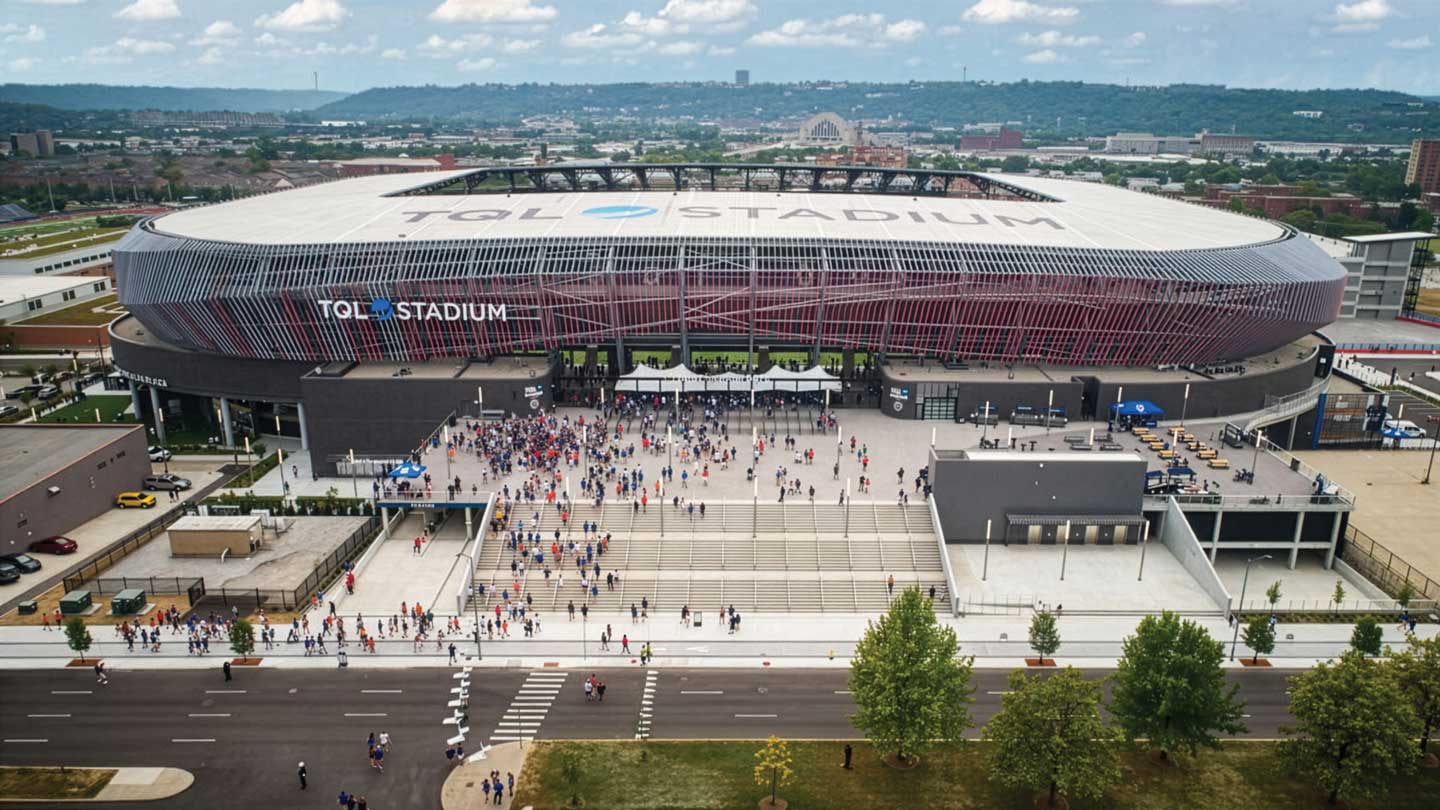
A rigorous due diligence process greatly improves the odds of funding and successfully developing these ambitious undertakings.
Mixed-use districts, especially those tied to sports and entertainment, are among the most exciting — and challenging — projects in real estate. When they work, they transform communities, lift values and create year-round activation. But when early assumptions are soft, schedules slip, costs climb and investors can lose confidence. That’s why thorough predevelopment planning is critically important.
Because these districts blend public and private financing, civic interests, large-scale infrastructure and unique timelines, predevelopment due diligence is not just a box to check. It is the foundation of the capital story. Done right, it converts uncertainty into bankable assumptions and unlocks funding.
Several essential elements determine the feasibility of mixed-use projects.
Team Building
Predevelopment is the highest-risk phase of any project, so getting the team and the governance correct up-front is crucial.
As a development advisory firm with experience in both facility development and operations, McCullers Group focuses the first phase of almost every project on assembling the right people and establishing clear roles and responsibilities.
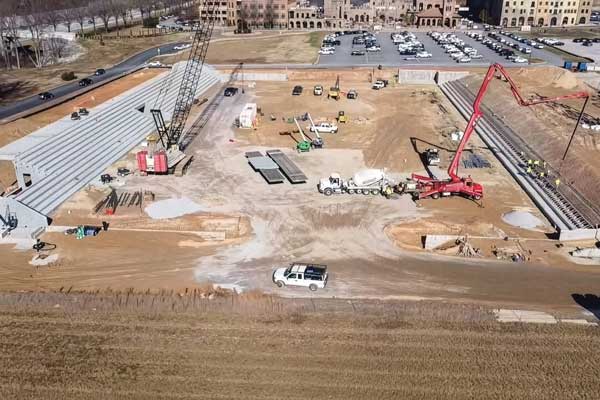
The in-progress GE Vernova Park at BridgeWay Station, a mixed-use development in the growing upstate region of South Carolina, will serve as the future home of the Greenville Triumph and Greenville Liberty soccer teams. Edifice Construction
For a university-adjacent mixed-use initiative with a multiuse stadium component in North Carolina, this meant building an early coalition of stakeholders and technical partners critical to assessing land and project feasibility before any design work began. This coalition included university leadership, athletic administrators, land use and governance counsel, civil engineers familiar with soil and utility constraints, capital markets advisers, land planning experts, and a team of regionally based architects and contractors.
In a suburban community in Texas preparing for a major multifield sports and recreation complex, the primary challenge was coordinating expectations across public agencies and ensuring the project’s road map aligned with established policies, regulatory frameworks and available resources. Equally important was managing the interface between public sector entities and private sector stakeholders who would play key roles in advancing the project. Those early discussions established realistic parameters for scope, funding, procurement and operations, enabling a smoother feasibility path.
These processes echo what McCullers Group sees across leading sports and entertainment district projects: Early collaboration and clearly defined roles are essential to avoiding rework, building trust and ensuring the predevelopment program delivers actionable, defensible outcomes.
Concept and Site Planning
Not every parcel of land is suited to projects like these. That is why early test fits and program studies should run in parallel with civil diligence. These include surveys for geotechnical issues, soils, groundwater, utilities, traffic, grading, flood plain and access. The goal is to quantify risks and mitigation costs before design runs ahead of reality. At this stage, concept plans are not final designs; they are tools that tie physical options to schedule and cost.
Concept planning is where enthusiasm meets the realities of land, infrastructure and budgets. In a venue-anchored district project in North Carolina, the site had strong potential but came with steep grades, aging utility infrastructure and proximity to a high-volume transportation corridor. Instead of forcing a predetermined vision, multiple test fits were conducted to examine how housing, structured parking, hospitality, green space and a 5,000-seat multiuse sports and entertainment venue could best coexist within the site’s roughly 40 buildable acres. These iterations shaped not only the site plan but also the financial model, entitlement path and phasing strategy for the project.
A different set of considerations arose with a feasibility assignment for an entertainment district centered around an existing events venue in the Southwest. There, focus revolved around access sequencing, circulation during peak event times and the integration of daily mixed-use activity without overwhelming surrounding infrastructure.
With campus-edge work, site planning often involves reconciling growth ambitions with institutional character, including respecting academic adjacencies, prioritizing pedestrian movement, and ensuring that new development enhances rather than competes with the existing environment.
Across all settings, early site planning reveals what the land can accommodate, what constraints require mitigation and how a project must adapt to be viable.
Market and Economic Impact Studies
Every stadium-anchored mixed-use district depends on demand that extends well beyond event days. A credible market analysis will inform demand for ticket sales, hotel keys, residential unit mix, retail mix and office space to show what can be supported. A complementary economic impact study clarifies public benefits, such as jobs created, taxes and tourism dollars generated, so the entitlements and public funding conversations rest on facts rather than hype.
In fact, market studies often represent a turning point in discussions about project feasibility. In many venue-driven districts, stakeholders initially assume that a stadium or athletics component will generate enough activity to sustain the surrounding development. In reality, market fundamentals often demonstrate the need for complementary uses, such as residential density, food and beverage offerings, and flexible event programming, to maintain activity beyond core event days. This dynamic occurs frequently in emerging markets and early stage district concepts.
In another Southwestern community evaluating a multifield recreation complex, an economic impact study became the primary communication tool for public leaders. The analysis translated an aspirational idea into measurable outcomes, including incremental tax revenue, visitor spending, job creation and year-round programmatic benefits. This data grounded public discussions in objective information rather than speculation.
The long-term success of venue-anchored districts is strongly tied to programming diversity, integrated land uses, and alignment between the venue and the broader economic ecosystem.
Public and Government Relations
No stadium-anchored district, university district or mixed-use entertainment district exists in a vacuum. Regardless of the market, public and government relations are inseparable from predevelopment and often play significant roles in whether a project moves forward. An effective public affairs plan encompassing briefings, a community benefits narrative and a clear entitlements path can build trust and reduce surprises. At the same time, government relations are vital when it comes to generating project support and approvals. Focus should be placed on aligning infrastructure scope, approvals and timing with the project’s critical path rather than the tempting approach of chasing headlines.
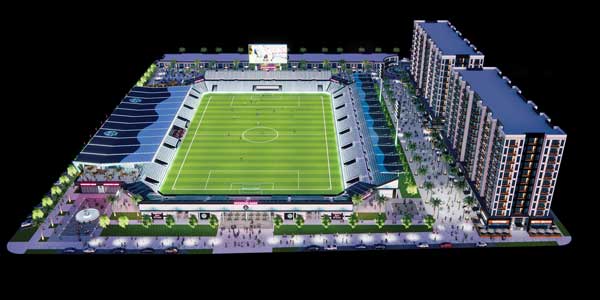
A rendering of the professional soccer stadium envisioned to anchor the Walton & One mixed-use development coming to Port St. Lucie, Florida. McCullers Group is serving as owner’s representative to United Soccer League franchise Port St. Lucie Sports Club. LaBella Associates
McCullers Group’s approach is to share the project vision with elected officials and community stakeholders early in the process to gauge interest and collect feedback. Additionally, the firm communicates with multiple departments and defines roles and expectations to ensure transparency and efficiency.
In Texas, a structured public sector engagement strategy was essential for a stadium-anchored mixed-use development that will include additional fields as part of a regional sports tourism complex. Other components include a hotel, more than 500 units of multifamily housing, retail and an events center. Before any public announcements, McCullers Group guided the client through targeted briefings with internal departments, elected leadership, business groups and adjacent property owners. These sessions clarified what the project is and what it is not, setting expectations related to infrastructure, financing, community benefits and long-term operations.
Across all project types — campus, municipal or privately sponsored — the way a project enters the public arena almost always determines whether subsequent steps will unfold collaboratively or adversarially.
Legal Review
Legal counsel is necessary on several fronts with mixed-use projects. Beyond forming the right legal entities, the legal team will need to conduct a rigorous review of title, easements, use restrictions, existing agreements and other elements that could limit operations or phasing. Early on, the ground lease or land purchase documents need to be aligned with market economics and the project pro forma (rent, escalations, public improvements credits and other terms) to drive feasibility.
Legal diligence is one of the most consequential components of predevelopment. It is often where unforeseen risks emerge. On a campus-edge project in North Carolina, legacy easements, restrictive covenants and cross-access requirements — some decades old — would have constrained utility placement, emergency access, site circulation and building placements. Identifying these issues early allowed the master plan to be adjusted and modifications to be negotiated before they became costly barriers.
In municipal sports and recreation projects, legal review often determines ownership structure, operational responsibilities, liability, funding mechanisms and long-term maintenance requirements. These factors directly influence feasibility, particularly when public entities and private partners share responsibilities.
The ability of a private operator to program as many events within a facility as possible, and to drive revenue opportunities from things like parking, concessions and sponsorships, is critical for long-term success, both operationally and financially. The right to expand a facility’s size and scope to meet community need and market demand is also important. The ability of both sides, private and public, to interact as partners during planning and after the project is completed is also critical. For example, the private side can allow a municipality to use the venue for certain public programming that would help market the city and benefit the community, while the city can help shoulder some of the funding and maintenance risk to support long-term financial stability.
Capital and Funding Readiness
Diligence is the on-ramp to capital. Lenders and investors underwrite a cohesive sources-and-uses schedule, a realistic capital stack and an operating model, not renderings. The objective of predevelopment is a financeable package: program and test fits, a cost plan, a schedule, a detailed operating model and business plan, an entitlements road map, a public improvement scope, and term sheets that reflect risk allocation.
In municipal and university settings, capital readiness often involves coordinating public budgets with phased development plans, aligning funding tools with project timing and preparing structures that allow private participation where appropriate.
With larger entertainment districts and mixed-use projects, capital readiness may include evaluating partnerships, layering public and private funding mechanisms, and creating operational structures that ensure long-term financial sustainability.
Across these varied contexts, being “capital ready” is not about presenting a polished vision. It is about demonstrating a structured, defensible, sequenced plan that aligns with how capital markets evaluate opportunity and risk.
Time and Cost Reality
Proper predevelopment takes time and money. Getting the site under control, completing the ground lease, doing site work and setting budgets should all happen before detailed design sets are produced. That process will need to be about 90% complete before moving on to permitting approvals.
Depending on location and site complexity, expect to spend $500,000 to more than $1 million over the course of the predevelopment process to reach a bankable concept. That’s the cost of doing business in this space, but a thorough predevelopment process will help project teams avoid much more costly schedule delays, budget overruns and quality issues.
Beautiful renderings raise eyebrows, but due diligence raises capital. Teams that insist on rigorous feasibility, transparent data and experienced advice dramatically improve their odds of funding — and, ultimately, delivering — a mixed-use project that opens on time and subsequently performs.
Cortland McCullers is the director of predevelopment planning at Ohio-based real estate development advisory firm McCullers Group.