Industrial real estate pivots from speed to precision, prioritizing power, automation and regional supply chain strategies.
As the industrial sector’s unprecedented two-plus-year supply surge from 2022 to 2024 grows ever more distant, developers are confronting a market that no longer rewards speed alone. Today’s industrial landscape demands a much different calculus.
Given that new reality, developers are increasingly weighing electrical power availability against automation specifications, evaluating nearshoring corridors alongside energy infrastructure, and balancing sustainability mandates with construction costs.
CBRE reported that industrial leasing remained solid in the third quarter of 2025 as occupiers upgraded facilities, renewed expiring leases and continued outsourcing to third-party logistics providers (3PLs). Strong leasing combined with less new construction held the national vacancy rate at 6.6%, reversing a string of quarterly increases. Year-to-date leasing rose 9.8% to 682 million square feet, led by 3PL demand, while net absorption of 53.3 million square feet in the third quarter pushed the year-to-date total to 79 million square feet. Construction completions continued to outpace absorption, with space under construction rising to 226.9 million square feet.
These metrics point to a market in transition — not contraction. CBRE data shows U.S. net lease investment surged roughly 24% in the third quarter of 2025 to $48.1 billion, with industrial leading that category, underscoring continued investor interest despite broader market uncertainties.
Speed and Volume: No Longer the Top Priorities
“During and immediately after the COVID-19 pandemic, the industrial sector operated with a mindset focused on sheer construction volume, responding to unprecedented demand for space,” said Stephanie Rodriguez, national director of industrial services at Colliers. “Between mid-2022 and mid-2024, more than 100 million square feet of new supply was delivered each quarter for nine consecutive quarters.”
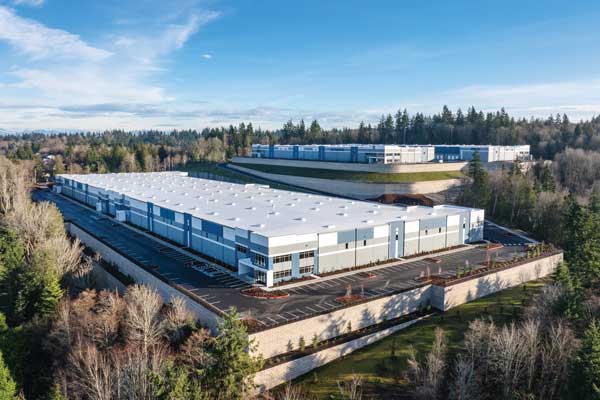
Bridge Point Soundview is a 40-acre Class A development in the heart of Everett, Washington’s industrial/flex hub outside of Seattle. Courtesy of Bridge Industrial
Since then, development has slowed significantly, she added, falling below prepandemic levels. The third quarter of 2025 saw just 65 million square feet of new supply, the lowest total since the first quarter of 2019.
“Today, construction is increasingly defined not by quantity but by quality, utility and operational readiness,” Rodriguez said. “Modern industrial buildings are designed to meet complex tenant requirements, including heavy and reliable power, automation compatibility, and integrated data infrastructure to support smart warehouse operations.”
When the industrial market was having a major upswing, developers were primarily focused on speed and volume, pushing to deliver as much product as possible to keep pace with extraordinary leasing velocity, according to Stefan Sansone, senior vice president of investments for Chicago-based Bridge Industrial.
“Now that activity has stabilized, developers are taking a more selective approach,” Sansone said. “The emphasis has shifted toward high-quality locations, stronger access and more efficient site design. Thoughtful execution matters just as much as speed.”
During the pandemic building boom, some developers might have been tempted to compromise on functionality and site plans to deliver buildings as quickly as possible, said Ronel Borner, senior vice president, development, CenterPoint Properties, a developer of industrial real estate near Chicago’s logistics hubs.
“Now, the flight to quality includes not just a product but product that is well designed,” Borner said. “At CenterPoint, we’ve always made sure we’ve designed buildings that are not only in grade A locations but also have Class A designs. We build and invest for the long term.”
Supply Chains Go Regional — and Cross Borders
Another strong force in the new industrial cycle is what Rodriguez called “supply chain restructuring,” with industrial occupiers shifting away from a single-hub distribution model to a more regionalized approach.
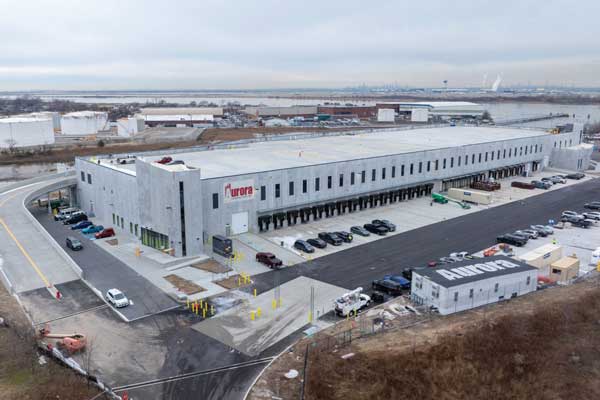
CenterPoint Properties’ two-story, 130,466-square-foot industrial development next to JFK Airport in Inwood, New York, is being completed in the first quarter of 2026. Courtesy of CenterPoint Properties
“This shift shortens lead times and reduces disruption risk,” Rodriguez said. “The adjustment is resulting in additional demand, particularly for midsize facilities that range from 100,000 to 400,000 square feet [and] larger primary distribution and fulfillment centers with 500,000-plus-square-foot requirements.”
“After a period of rapid expansion, industrial customers are now optimizing their supply chains,” noted Matt Mullarkey, senior vice president, strategic planning and projects, CenterPoint Properties. “Companies are inventorying their assets, identifying excess capacity and investing in automation where it drives profitability.”
This restructuring is happening against a backdrop of reshoring and nearshoring that is shifting production closer to the end market to shorten supply chains. Nearshoring to Mexico is meaningfully shifting freight flows and industrial demand toward border markets such as Laredo and El Paso, Texas, and into inland logistics corridors such as Dallas-Fort Worth, Kansas City and Chicago.
On the reshoring side, the CHIPS and Science Act continues to drive a wave of advanced manufacturing. The federal statute, enacted in 2022, includes nearly $53 billion in incentives for U.S. semiconductor manufacturing and a tax credit worth 25% of qualifying investments in advanced manufacturing facilities, often measured in the tens of billions of dollars per site. Manufacturing construction spending in the U.S. has more than doubled compared with prepandemic levels.
“We’re absolutely seeing a renaissance in manufacturing in the United States,” said Jack Fraker, president, global head of industrial and logistics capital markets for Newmark. “You look at Samsung’s $40 billion plant near Austin. You look at Tesla’s manufacturing in Austin. Those anchor facilities immediately attract suppliers and vendors who want to be located right next door. That clustering effect is happening all over the U.S.”
Sansone sees reshoring emerging even in mature, high-cost markets: “The northern New Jersey industrial market is experiencing a notable shift. Users are increasingly leasing larger units to hold greater inventory levels and maintain excess capacity in preparation for peak season. … In addition, activity from local manufacturing users has grown. Many of these companies cite both the broader reshoring movement and available government incentives as key reasons they are now prioritizing U.S. locations for their manufacturing operations. Previously, they would have focused solely on lower-cost international markets.”
The Influence of Automation and Robotics
The shift toward automation is no longer theoretical. It is now embedded in the way new industrial buildings are being designed and engineered.
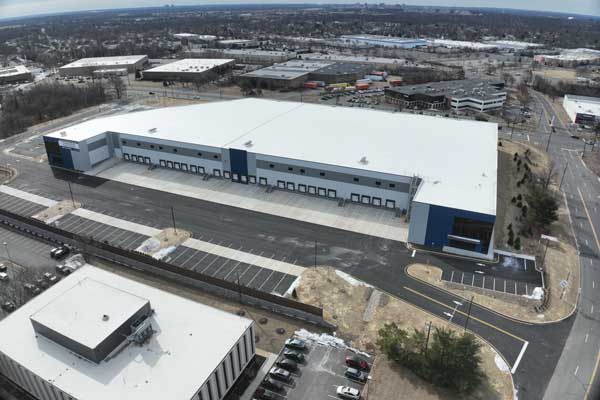
Bridge Point South Plainfield II is a 167,281-square-foot distribution facility. With direct access to Interstate 287, the New Jersey Turnpike, Interstate 78, Route 1-9, Newark Liberty Airport and Port Elizabeth, the facility offers easy connectivity to key transportation corridors. Courtesy of Bridge Industrial
“Most modern speculative facilities meet requirements of around 36 feet to 40 feet clear for most automation infrastructure, although robotics-heavy operations benefit from extra vertical volume,” Rodriguez explained. “Automation demands higher slab load capacities for equipment and concentrated rack loads. As a result, developers increasingly design slabs with heavier reinforcement. Technology and automation are redefining power and digital infrastructure requirements, and power has become the most important spec for automation-enabled operations.”
The shift is driven by the economics of warehouse operations. As labor costs rise and throughput requirements increase, occupiers are investing heavily in automated systems to maintain efficiency and service levels. “In many cases, the cost of interior improvements, including conveyors, robotics and sortation systems, exceeds the cost of the building shell itself,” Fraker said.
“Some of these facilities literally have miles of conveyor belts inside,” Fraker continued. “Every new RFP [request for proposal] that goes to a developer adds another layer of expectations — more power, more improvements, more automation readiness.”
Andrew Hurwitz, partner, East region, Bridge Industrial, framed the issue this way: “Balancing future readiness with practical cost management is a key challenge for speculative developers. Given the significant up-front investment, it’s essential to design facilities that incorporate not only today’s best-in-class features, but also the elements likely to become industry standards in the years ahead.”
At the same time, he cautioned, user needs vary widely. Developers must take care not to overextend project budgets on specialized features that only a small subset of tenants might ever require.
Primo A.J. Fontana, partner in global law firm DLA Piper, said his industrial real estate clients routinely bring up features such as floor flatness, floor load capacity, robotics and clear heights. Sometimes the specialized improvements are in only part of the building, but they are critical to performance. This ties back to build-to-suit: Tenants want space engineered specifically for their process.
Power: The Ultimate Site Selection Filter
Electrical capacity has become the single most critical constraint in industrial site selection (for more, read Development’s Winter 2025/2026 cover story, “Power Strain: Inside CRE’s Race to Secure the Next Megawatt”). This shift has been driven by three converging forces:
- The explosive growth of data centers.
- The increasing power demands of warehouse automation.
- The electrification of logistics fleets.
Together, these trends have strained utility capacity across key distribution markets and added months or even years to development timelines.
Utility timelines have been further stretched as demand for transformers, turbines and other substation equipment outpaces manufacturing capacity. In multiple markets, developers report multiyear delays before utilities can provide the necessary power to a site. The scale of data center projects compounds the issue. A single hyperscale facility can require as much electricity as a small city, straining regional grids and forcing utilities to prioritize large contracted users over speculative developments.
For industrial developers, the result is a fundamental shift in the site selection sequence. Traditionally, developers would identify a location based on logistics fundamentals — proximity to highways, intermodal terminals, labor pools and consumer markets — and then work with utilities to bring power to the site. In many markets, that order has been reversed.
Lauren A. Rico, partner, DLA Piper, explained the new dynamic: “AI is a huge driver. An AI query can use 10 times the power of a standard Google search. Developers are forming collaborative relationships with utilities because power access now determines whether a project is feasible. It’s reversed the old formula of the tenant first, then power.”
“In many markets,” Fontana added, “utilities won’t even talk to a developer unless there’s already a tenant committed. That flips the development sequence and makes speculative building more difficult.”
Competition for power has prompted many developers to explore on-site generation. “We’re seeing a real shift toward on-site solutions, especially solar,” Fraker said. “If you look at a company like Prologis, they have 1.3 billion square feet of roofs. All of that is being converted into solar generation that can power the warehouse and even charge delivery fleets in the truck court.”
Solar installations provide both operational benefits — such as reducing tenant energy costs and supporting sustainability goals — and strategic advantages, particularly in markets where grid power is constrained or expensive.
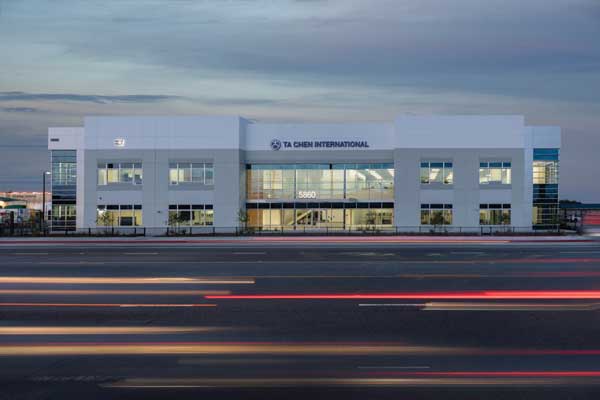
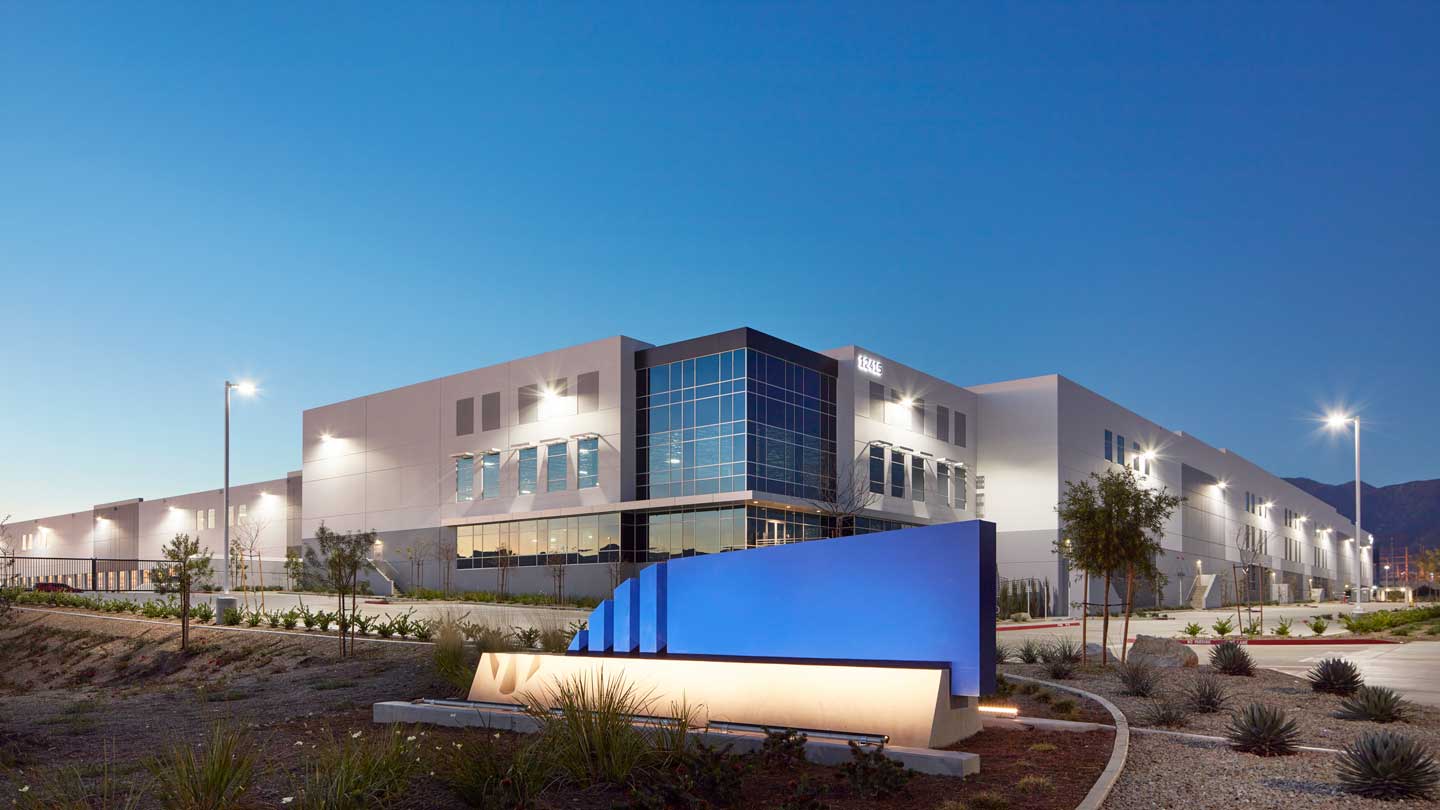
CenterPoint Properties delivered a build-to-suit distribution facility near the Port of Long Beach in California that also serves as the U.S. headquarters for Ta Chen International Inc. The 129,300-square-foot Class A facility includes a two-story, 42,700-square-foot office, four docks, three drive-ins, a 32-foot clear height and parking for 164 cars. Courtesy of CenterPoint Properties
The energy conversation is also broadening beyond solar. Small modular nuclear reactors are being discussed as a longer-term solution for industrial clusters and manufacturing campuses that require reliable baseload power. Natural gas generation is experiencing renewed interest in the United States, supported by abundant domestic supply. Wind capacity continues to expand in states such as Texas and California, contributing to regional grids that serve industrial tenants.
For speculative developers, the challenge lies in designing buildings that can accommodate a wide range of tenant power requirements without overbuilding infrastructure that only a narrow subset of users will need.
Sansone outlined the approach: “Varied uses and users require different charger, battery and peak-load requirements. Speculative developers should plan for increased power capacity and incorporate conduits throughout warehouse interiors and parking areas. This approach ensures tenants can integrate their own equipment and operate effectively regardless of their specific charging or battery systems.”
Data Centers: Friend or Foe?
Considered from the outside, a data center building looks like a standard industrial box writ large. Inside, however, it is another world, with billions of dollars’ worth of equipment, plus staggering power and cooling infrastructure.
Given that scale, Rodriguez noted, the cost of land is almost an afterthought. That means data center developers can and frequently do outbid traditional industrial developers for prime sites.
Fraker offered a real-life example: “A developer in North Texas assembled land for a Class A logistics park. He checked everything — freeway access, intermodal rail, labor, population. Out of the blue, one of the hyperscalers called and asked to buy the entire site, offering four times what the developer paid. So the developer said yes. That’s happening all across the country.”
Fontana put it this way: “Data centers are not industrial in the traditional sense, but industrial uses absolutely follow data centers. Data centers need continuous supplies of replacement chips, switches and hardware, and that demand creates warehouses dedicated to supporting their operations nearby. We’re seeing this across more markets than ever, [including] Utah, Indiana, Pennsylvania [and the] Mountain West states.”
Traditional industrial developers might view data centers as both competitor and catalyst. While they take some of the best land off the table, they also create new, steady demand for high-spec industrial nearby.
Flight to Quality: ‘Good Enough’ No Longer Clears the Bar
As capital, tenants and lenders recalibrate, the industrial sector is drawing a sharper line between assets that can compete and those that cannot. Across markets, tenants are committing more selectively, favoring buildings that can support automation, electrification and long-term operational flexibility. That shift is accelerating a decisive “flight to quality,” according to those interviewed.
“Tenants are abandoning older buildings that can’t support modern technology, automation or sustainability expectations,” Rico said. “New developments are increasingly built around exactly what a tenant needs.”
Industrial developers are seeing the same pattern on the ground. Borner described a market where design quality now directly influences leasing velocity and capital access. “It’s the best-designed buildings in the best locations that are and will be the winners,” he said. “Tenants want the best product available, and developers are investing in highly functional buildings.”
From an owner’s and portfolio-planning perspective, that selectivity is reshaping how tenants allocate space, with companies increasingly favoring fewer, higher-quality assets that can support automation and future operational demands, according to those interviewed.
Demand Outlook and Geographic Winners
“Leasing activity is expected to remain steady over the next five years,” Hurwitz said. “Users continue to seek modern space, but with a significant amount of new supply coming online, it will take time for demand to fully catch up. The industry broadly anticipates that vacancy will return to post-COVID levels by late 2026 or early 2027.”
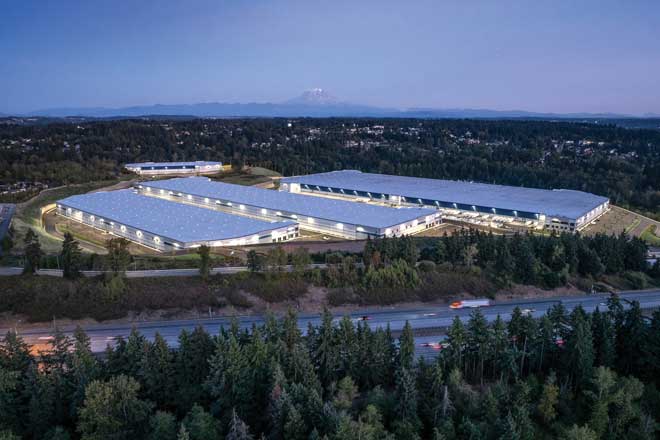
The Bridge Point I-5 Seattle logistics campus features over 1.9 million square feet of building space, expansive trailer and auto parking, ample dock positions and high-clearance warehousing, all designed to support large-scale operations with precision and speed. Courtesy of Bridge Industrial
Rodriguez described the market transition: “Leasing has already bottomed and started to recover. In [the third quarter] of 2025, demand reached its strongest level since early 2023, vacancy continued to stabilize and new leasing increased across all size segments. With development bottoming out and demand rebuilding, the market is transitioning toward a more balanced phase.”
Geographically, two categories of markets are emerging as particularly attractive: high-growth Sun Belt metros and constrained coastal markets.
“The Sun Belt states are major beneficiaries of population growth,” Fraker said. “People are leaving high-cost, high-tax states and moving to Texas, Florida, Georgia, Tennessee. Dallas-Fort Worth is on track to be one of the largest industrial markets in the entire country.”
Fraker also highlighted the industrial renaissance happening in the Midwest, particularly around Chicago, Cleveland, Cincinnati, Indianapolis and Detroit. “These markets have skilled, generational manufacturing labor. That labor force is a huge competitive advantage as advanced manufacturing comes back to the U.S.”
Rodriguez noted that markets where demand growth is strongest, such as cities across the Sun Belt and near expanding ports, will see their fundamentals rebalance in short order. At the same time, markets with higher supply side barriers, such as Southern California and New Jersey, offer rental rates well above the national average.
Nearshoring is also firing up some market activity along the U.S.-Mexico border. According to those interviewed, Laredo, El Paso, McAllen and their outskirts are rapidly becoming some of the most strategic logistics nodes in North America.
Ron Derven is a contributing editor to Development magazine.
ESG: From Box-checking to InfrastructureESG — environmental, social and governance — is becoming more infrastructure-driven in industrial real estate. Stefan Sansone of Bridge Industrial noted that tenants are increasingly focused on electrification-ready buildings, strengthening the position of owners who anticipate associated needs. Installing highly specialized infrastructure on a speculative basis is less common, Sansone warned, as hardware and operational needs continue to evolve rapidly. Ronel Borner of CenterPoint Properties noted that institutional companies continue investing in ESG, including solar and other renewables. “ESG requirements impact site design and budgeting,” Borner said, “as space and budget need to be allocated for the necessary infrastructure. Achieving LEED standards remains common among top developers, and we at CenterPoint have focused our investment efforts on battery-powered solar.” |