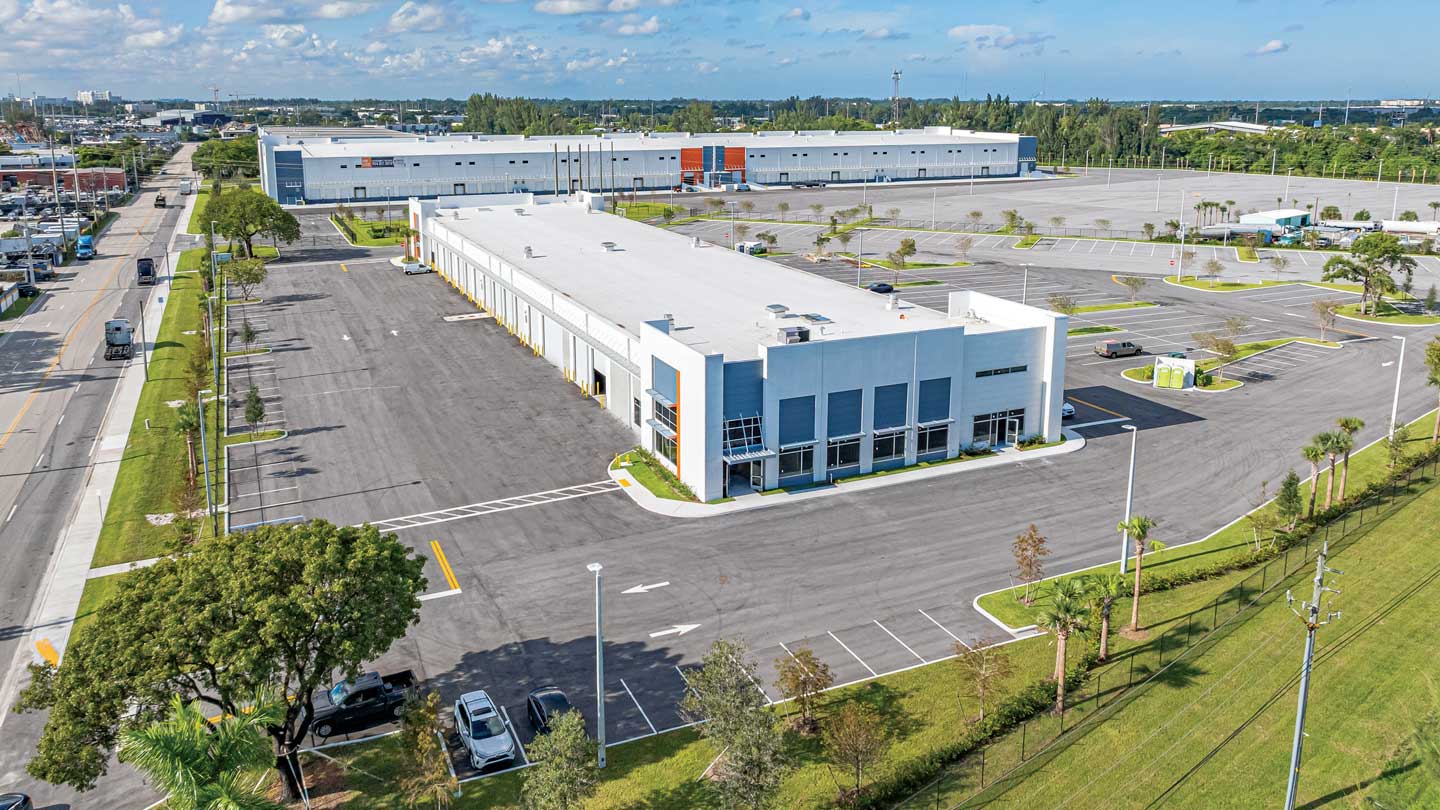
Mostly owned by mom-and-pop investors, industrial outdoor storage properties are increasingly eyed by Wall Street.
Commercial real estate investment firm CanTex Capital has been acquiring industrial outdoor storage (IOS) properties since its founding in 2018, focusing on the Dallas-Fort Worth area. Of the 46 commercial properties it purchased last year, approximately two-thirds of them were IOS, and most were existing IOS sites. More recently, it has begun acquiring properties and developing IOS sites on spec, designing them based largely on input from existing customers.
“We’re using that experience, that data, to inform what we’re doing now on the development side,” said Jay Malhan, the company’s vice president of acquisitions.
In October, CanTex sold a portfolio of eight IOS properties to Stockbridge Capital Group, a San Francisco-based private equity real estate investment management firm and a major aggregator of IOS properties nationwide.
“That will probably be our last IOS portfolio sale,” Malhan said. “We find these sites to be incredibly rare, and it’s a lot of work to aggregate them. We’re seeing such strong fundamentals in the space that, moving forward, we will likely be long-term holders on the IOS side.”
IOS properties, providing mostly outdoor storage for vehicles, heavy equipment and other industrial products, have existed for decades. In recent years, however, IOS has emerged as a distinct investment asset class that is heating up in a big way. Aggregators such as CanTex and Stockbridge are gobbling up existing IOS properties as well as several-acre plots of land that they can convert to IOS. And major Wall Street players, including J.P. Morgan and private equity giant Blackstone, are stepping up with financing options. Nevertheless, the market remains highly fragmented and ripe for consolidation, with only an estimated 7% to 10% of it controlled by institutional investors, and the vast majority in the hands of mom-and-pop owners.
IOS Builds Strong Fundamentals
Tom Barbera, CEO of Industrial Outdoor Ventures, a significant aggregator in the IOS arena, spotted the market’s opportunities over 20 years ago. Back then, it was often referred to as “low coverage industrial,” with typically only 10% to 15% of the property an enclosed structure and the rest open land. Barbera and his partners purchased 10 IOS properties in the Chicago area and, after proving the asset’s strengths, raised money from investors in 2015 before launching Industrial Outdoor Ventures a year later.
“It’s got great fundamentals,” Barbera said, noting the high barrier to entry and limited supply. The properties turn over infrequently, and most communities are averse to new IOS.
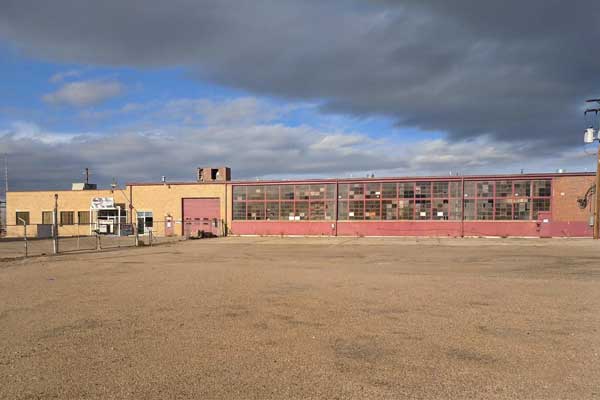
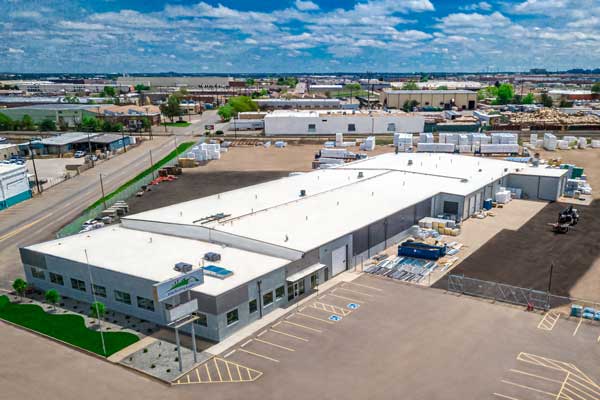
Industrial Outdoor Ventures completed a value-add redevelopment of a 51,162-square-foot warehouse in Denver (above). The new property (below), including IOS, is leased to Elite Roofing Supply and the city of Denver. Courtesy of Industrial Outdoor Ventures
In a September 2025 report, Newmark estimated IOS taking up 1.4 million acres nationwide, approximately the size of Delaware. “Yet well-located sites remain scarce due to zoning,” the report noted.
At the same time, demand from a diverse selection of tenants is steady if not increasing. Barbera said customers leasing IOS properties tend to be businesses in mature industries that are seeking space to store tractor trailers, parcel delivery fleets, school buses, shipping containers, heavy off-road equipment and building materials.
“They all need IOS, so it’s a vast number of industries,” Barbera said. He estimated the market size at $200 billion across the top 30 metropolitan statistical areas and $300 billion across the top 48.
The term “IOS” emerged about five years ago, according to Sam Dragan, first vice president at CBRE. He noted that institutional interest in IOS heated up in the wake of the COVID-19 pandemic, with the “overarching trend of businesses wanting to be as close to their customers as possible.”
That was especially true in high-growth cities in the Sun Belt, which saw a significant influx of construction to accommodate new residents and supporting businesses. IOS properties were essential to storing building materials as well as construction and landscaping equipment.
Significant IOS activity has also occurred in coastal port cities and in the Midwest around transportation companies’ hubs for distributing goods regionally, Dragan said. IOS sites often double as locations for cross-country truckers to drop goods to be picked up by smaller delivery vans and as overnight rest stops for drivers.
“They’re really the backbone of the supply chain, these properties that were overlooked 10 years ago and now are under the spotlight of developers and investors,” Dragan said.
IOS properties have tended to have long-term tenants, and “more often than not, groups aren’t moving from these spaces,” Dragan said. “Instead they are just seeking additional locations within the city [where] they operate.”
Barbera pointed out that while office buildings can be “super capital intensive to upfit,” the basic improvements that acquirers of IOS properties make — new fencing, lighting, overhead doors, parking lots — require relatively low capital outlays and are viewed as generically valuable by a wide range of occupiers.
A Changing IOS Landscape
In a more recent development, data centers, accompanying power stations and other major infrastructure projects have driven demand for nearby IOS sites to store concrete, steel and other building materials, in addition to heavy construction equipment. Newmark’s report also pointed to the increasing need for specialized charging and maintenance networks on IOS sites to support evolving technologies, such as advanced air mobility and autonomous vehicle fleets. It deemed them catalysts for increasing institutional investment, “transforming IOS from a niche, fragmented market into a maturing, standardized asset class.”
Ultimately, the big draw for institutional investors has been the rent increases bolstering the asset class and the anticipation that the trend will continue.
“IOS rents increased 123% since 2020, more than twice the rate of bulk warehouses. Phoenix, Memphis and Atlanta top the IOS rent growth list,” according to Newmark.
Vytas Norusis, head of Partner Valuation Advisors’ national IOS practice group, said today’s IOS investors run the gamut from affluent retail investors to major private equity firms and, increasingly, insurance companies. Aggregators such as Alterra IOS and Industrial Outdoor Ventures typically aim to pool IOS properties — usually 20 or more, with each property valued between $5 million and $15 million — with the intent of eventually selling the asset pool or a stake in it to institutions seeking long-term investments.
“In the past year, we’ve worked on almost 300 IOS appraisals for Blackstone and some of the largest institutional lenders,” Norusis said. “It’s really accelerated recently.”
Some of the big institutional transactions include two joint ventures closed in 2024 by Zenith IOS with institutional investors advised by J.P. Morgan that anticipate owning $1.5 billion in IOS properties nationwide. In June 2024, Fortress Investment Group, an early entrant into the space, refinanced numerous IOS transactions totaling $708 million via a $493 million commercial mortgage-backed security (CMBS) and a $213 million balance sheet loan.
“Over time, we would expect IOS assets to be valued in line with, if not in excess of, traditional industrial assets given the zoning controls around new development and the scarce supply of infill transportation-oriented buildings,” said Tom Pulley, global head of real estate equity for Fortress, in a statement.
In February 2025, originator Alterra IOS announced closing a $189 million loan commitment from Blackstone to buy 49 IOS sites across 22 states. Later in June, Blackstone provided Jadian Capital with $231 million to finance a portfolio of 43 IOS properties across 13 states. Then in July, Alterra procured a $343 million loan commitment from Truist Financial and Bank of Montreal that is secured across 64 IOS properties, increasing its institutional financing to $1.5 billion. In August, Barings, a global real estate investment manager, announced forming a joint venture with Brennan Investment Group to acquire an initial $150 million in IOS assets.
“The seed asset and goals of our new venture with Brennan represent a high conviction strategy and asset class for the firm,” said Raymond Tiernan, director at Barings, in a press release. “Together, we aim to capitalize on the growing institutional demand for IOS assets by leveraging Brennan’s deep sector expertise and Barings’ institutional investment platform with the aim of bringing enhanced returns to our clients.”
Designing From Experience
CanTex Capital traditionally focused on the acquisition, development and operation of shallow-bay, Class B warehouses, a strategy that more recently led to it recognizing the value of IOS properties. The vertically integrated firm acquires, constructs and operates the properties and manages its IOS portfolio in-house, and it began developing new IOS properties on a speculative basis close to two years ago. It currently has three sites under construction in the 3- to 5-acre range, plus 14 sites in various stages of predevelopment.
“Some of the issues that come up with buying existing IOS properties just can’t be overcome by adding capex dollars, like building placement and functionality or yard functionality,” Malhan said. “Getting into development helps us now take all the data we’re getting from our existing customer base about the features, layout and functionality they would like to see.”
Among those features, Malhan said, are taller clear heights that enable a wider variety of equipment to enter the covered space, a trend already prevalent among traditional industrial Class A properties. Increasing the size of door openings, typically to 14 feet by 16 feet from the traditional 10 feet by 12 feet, has also become more popular.
“In our next iterations, we may even push to go to 16 by 20,” Malhan said. “In terms of the depth of our buildings, we want to be sure that tenants can accommodate a full-size trailer.”
To heighten security, the firm provides gated access and taller fencing on IOS sites when feasible, Malhan said, and it recently inked a deal to install electrified fencing to all its new development sites. Customers typically insure their assets stored at IOS sites, but operators want sites to be operable regardless of weather or other potential impediments.
“Our yards are designed with proper drainage in mind,” Malhan said. “For even heavy rain days, yard functionality is not obstructed.”
CanTex targets a broad tenant base focused on population-serving uses, including vehicle- and equipment-rental companies, building material suppliers, landscapers, HVAC suppliers and piping companies. “All the businesses that really power the community,” Malhan said. “We’re developing sites that are in locations close to highways and growing populations, which allows tenants to better service their customers and municipalities to generate tax revenue and additional employment.”
A Boon to Bank Portfolios
The strategy is attractive to Liberty Capital Bank, a Dallas-Fort Worth-based regional bank with $750 million in assets that has individually financed several of CanTex’s acquisitions.
“It allows us to build a loan portfolio with a diverse mix of tenants and geographies, which is what you want to see on a bank’s balance sheet,” said Luis Flores, senior vice president at Liberty Capital.
He added that there is no standard lending profile for IOS properties, which aggregators commonly buy from individual owners and improve somewhat to bring in higher-quality tenants. “Banks are typically senior lenders in the capital stack,” Flores said.
Industrial Outdoor Ventures, on the other hand, looks for opportunities nationwide. In December, it sold its interest in a joint venture with Stockbridge that was formed in 2021, and it is currently deploying a discretionary fund that has made 11 acquisitions, closing its most recent deal at the end of 2025.
“If we find a greenfield land site that’s priced right and has the right zoning, and we like the demand drivers in that submarket, we’ll do a ground-up spec,” Barbera said.
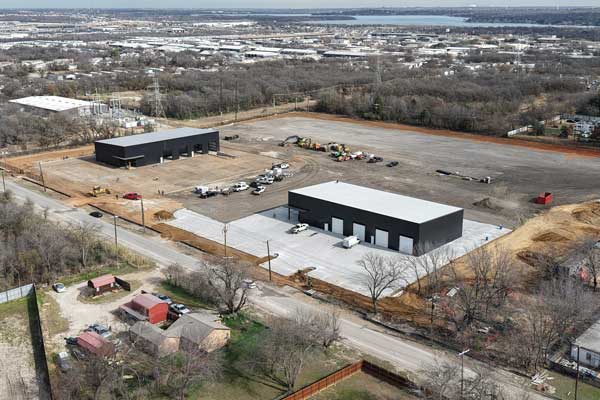
CanTex Capital’s speculative IOS development at 4729 Mansfield Highway in South Fort Worth, Texas, features two 5-acre sites, each with a 10,500-square-foot building. Courtesy of CanTex Capital
He added that IOS is rarely built on spec by developers because it’s perceived to cater to overly specialized user communities. However, Industrial Outdoor Ventures successfully builds spec product with characteristics that have broad appeal across key sectors such as transportation, heavy equipment, construction, and building material distribution.
“There are nuanced differences between how each industry designs their facilities, but grade-level drive-through maintenance buildings with yard are basically interchangeable across multiple industries,” Barbera said.
Industrial Outdoor Ventures invests in IOS properties alongside a private equity firm that helped the company procure its first large bank loan. Bank facilities are generally an interim step toward longer-term nonrecourse financing, such as CMBS or privately placing debt with a life insurance company or other institution.
So far, aggregators looking to sell IOS portfolios to replenish their coffers have found exit ramps to be limited. In late 2024, Alterra sold $490 million in IOS assets, about 20% of its portfolio, to Peakstone Realty Trust, a major office and industrial real estate investment trust. In February, Brookfield Asset Management announced that it had entered into a definitive agreement for a Brookfield private real estate fund to buy Peakstone for about $1.2 billion.
“We’re still in relatively early days in terms of consolidation of ownership in the IOS industry,” Norusis said. “One of the challenges now is that ... there haven’t been many data points to support an institutional exit. An aggregator can buy 100 assets, but what does the next buyer look like?”
Aggregators can still split 100 properties into smaller pieces that can be sold, so there is liquidity, Norusis said, but additional larger deals could broaden the market’s appeal to major institutional investors.
“That’s one of the things that folks have talked about — when there will be another deal to break the ice on a large portfolio sale,” he said.
Norusis added that while the lack of data and transparency may present a challenge to more mainstream Wall Street investors, some operators and aggregators view it as a competitive advantage because their better understanding of the market enables them to price the assets more accurately.
The challenges presented by the lack of data are compounded by the unique nature of the IOS market, in which the individual property sizes are small compared with other areas of commercial real estate, such as warehouses or offices. That results in a much higher volume of assets to work with. Plus, investors must dramatically adjust other factors. For example, IOS buildings typically cover around 10% of the property versus 40% or more for warehouses.
In addition, properties can differ significantly depending on variables such as the industries they’re catering to and even their topography.
“Texas is a relatively flat state, but the topography in a market like Atlanta introduces a whole different element of development risk and cost,” Malhan said. He added that legal jurisdictions can also vary widely, from Texas’ more business-friendly environment to the more regulated coastal cities.
Zoning is the No. 1 challenge, according to Malhan. Whether firms are developing IOS themselves or acquiring existing properties, they must ensure selected sites have proper zoning and entitlements to avoid challenges from municipalities that can be averse to IOS-type properties. In addition, he said, cities are increasingly placing overlays that could change how properties are zoned. CanTex has seen IOS users vacate sites after receiving pushback from municipalities. That means IOS developers and investors must research both current rules and what political winds could bring in the future.
“They have to make sure that when they’re underwriting these properties, they have a really good understanding of not only what’s there today but what could be there in a few months or a few years,” Malhan said.
John Hintze is a freelance writer in Newark, New Jersey. He writes regularly for publications covering banking, the financial and derivatives markets, corporate finance and risk issues.