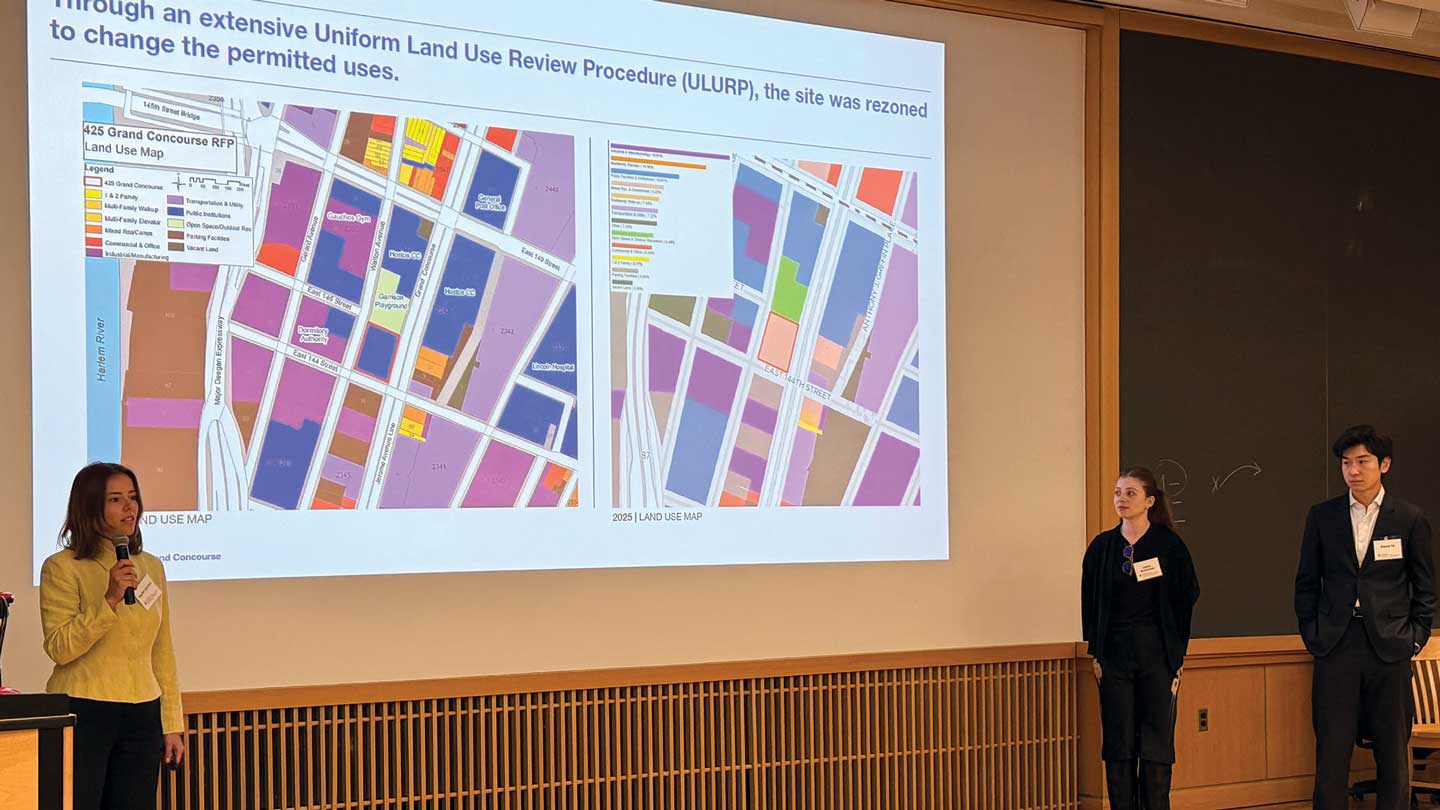
at the Colvin Case Study Challenge. Colvin Institute of Real Estate Development
Competitions such as the Colvin Case Study Challenge provide industry-aligned opportunities for workforce development.
As commercial real estate confronts structural shifts, ranging from capital market volatility and entitlement risk to sustainability mandates and changing patterns of demand, the industry’s need for well-prepared talent has never been greater. Firms across North America are asking not only where the next generation of developers will come from but how they are being trained.
One answer is emerging from a growing ecosystem of university-based real estate competitions. Among these, the Colvin Case Study Challenge, hosted annually by the University of Maryland’s Colvin Institute of Real Estate Development, has distinguished itself as a model for practice-driven, industry-relevant education.
More than an academic exercise, the Colvin Case Study Challenge mirrors the analytical rigor, judgment and communication demands that define real-world development work. This makes the competition — and similar competitions hosted by other universities — increasingly relevant to NAIOP members seeking talent ready to contribute on day one.
From Classroom Theory to Development Reality
The Colvin Case Study Challenge emerged from the same vision that gave rise to the Colvin Institute of Real Estate Development. Established in 2008 through a $2.5 million endowment from John and Karen Colvin, the Colvin Institute was founded on the belief that real estate development should be taught as it is practiced — at the intersection of finance, design, law, construction and community impact.
As the institute and its master’s program in real estate development matured, the Colvin Case Study Challenge was launched in 2016 to extend that philosophy beyond the classroom, creating a platform where students could rigorously analyze real, recently completed development projects and evaluate outcomes against original assumptions. The competition reflects the Colvins’ enduring commitment to experiential learning, ethical judgment and long-term value creation while reinforcing the Colvin Institute’s mission to prepare future developers for the complexity and responsibility of professional practice.
The case study challenge was designed with a clear premise: If students are expected to succeed in development careers, they must learn to analyze projects the way professionals do.
Each year, undergraduate and graduate teams from universities across the United States are invited to prepare in-depth written case studies of recently completed real estate developments from within their respective university’s region. Unlike many other real estate competitions, teams participating in the Colvin Case Study Challenge get to choose their projects. Eligible projects span residential, office, hospitality, retail and mixed-use developments, with parameters intentionally aligned to projects of meaningful scale and complexity. Projects must be 25 acres or less and have a total development cost between $25 million and $350 million, and the project or the project phase must be completed by 2020 or later.
Unlike hypothetical exercises, these cases focus on real projects that have moved from concept through execution and into operation. Students are required to examine developer vision, market context, site planning, financing structures, entitlement processes, construction challenges, sustainability considerations and operating outcomes. Crucially, they must assess how projects performed relative to original assumptions, serving as an exercise that demands honesty, nuance and professional judgment.
This retrospective approach sets the Colvin Challenge apart. Rather than asking students to design an idealized project, it forces them to confront the messy realities of development, including trade-offs, constraints and unintended consequences.
A Professional Standard of Evaluation
The competition unfolds in two stages. In the first round, teams submit comprehensive written case studies evaluated by a panel of industry professionals. From this pool, four finalist teams are selected to present in person at the University of Maryland.
“What makes the Colvin Case Study Challenge unique is that it asks students to reflect on what has actually been built in their own markets,” said Karen McGrath, Ph.D., assistant professor of finance at Bucknell University and a juror for the competition. “Students evaluate real benefits and costs using imperfect information — just as they will in professional practice.”
Final presentations are judged by experienced developers, lenders, advisers, faculty from outside of the University of Maryland and public sector professionals. The judges are often actively engaged in projects similar in scale and complexity to those being analyzed. Students are expected not only to present their findings clearly but to defend their assumptions under questioning that closely resembles an investment committee or partner review. The finalists are given 30 minutes to present before fielding an additional 20 minutes of questions from judges.
Evaluation criteria are intentionally broad and industry aligned. Judges consider market analysis, financial structure, design and sustainability strategies, execution risk, stakeholder engagement, operational performance and lessons learned. Communication skills matter as much as technical accuracy.
For students, the experience is demanding, with case studies typically due in mid-November and finalists presenting the first weekend of December. For industry jurors, it is often striking how closely the process mirrors professional development review, underscoring the competition’s value as a real estate workforce development tool.
“The two-phase structure — written analysis followed by live presentation — demonstrates mastery of the two core skill sets essential to successful real estate professionals,” McGrath said.
Since its inception, the Colvin Case Study Challenge has attracted participation from universities across the United States, including large public institutions, private research universities and smaller programs with strong real estate concentrations. Winning and finalist teams in recent years have come from institutions such as Columbia University, Clemson University, Auburn University, Virginia Tech and Penn State.
In 2023, the competition received a significant boost through a $200,000 grant from a private foundation, providing multiyear support for both the Case Study Challenge and the Colvin Capstone Competition, the master of real estate development’s culmination course. This funding expanded prize pools, enhanced programming and reinforced the competition’s national profile.
Why These Competitions Matter to NAIOP Members
The Colvin Case Study Challenge operates within a broader landscape of real estate competitions that play an increasingly important role in talent development.
Well known examples include the NAIOP Real Estate Challenges hosted by regional chapters. Other university competitions include Villanova University’s Mulroy Real Estate Challenge, focused on undergraduate development analysis, and Cornell’s International Real Estate Case Competition, which brings a global investment perspective. Even smaller universities with generous endowments host competitions, such as Monmouth University’s Kislak Real Estate Institute Competition, which requires students to propose redevelopment strategies for an existing site.
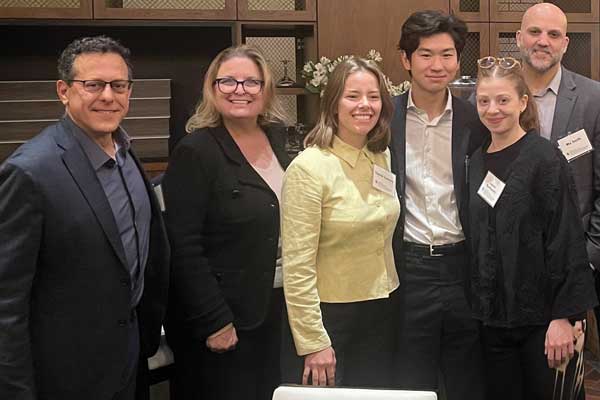
The winning team from Columbia University with the Colvin Case Study Challenge judges (from left): Alan Goldstein, Rock Creek Real Estate Development LLC; Karen McGrath, Bucknell University; Taylor Lowery, Columbia University; David Ni, Columbia University; Lama Barhoumi, Columbia University; and Mo Smith, Vorys. Colvin Institute of Real Estate Development
What distinguishes the Colvin Case Study Challenge within this ecosystem is its retrospective, performance-based focus. By emphasizing projects that have recently been built and operated, the competition teaches a critical but often underemphasized skill: learning from outcomes, not just intentions.
For firms across the NAIOP network, recruiting and developing talent is increasingly complex. Entry-level hires are expected to understand not only Excel models, but also how financing interacts with design, how entitlement risk shapes feasibility, and how community and political dynamics influence project timelines.
Students who have participated in the Colvin Case Study Challenge arrive with a clearer understanding of these realities. They have already practiced synthesizing disparate information, presenting to senior professionals and responding to critical feedback — vital skills that translate directly into professional effectiveness.
“The most valuable part of the Colvin Challenge was the chance to work alongside teammates I genuinely look up to,” said Taylor Lowery, a student graduating in May from Columbia University’s Master of Science in Real Estate Development program and a member of the winning team in the 2025 Colvin Case Study Challenge. “The experience pushed us to operate under real pressure, make decisions quickly, and translate a huge amount of information into a clear and compelling story.”
“The biggest lesson I walked away with is how important narrative is in real estate,” Lowery added. “The numbers matter, but how you frame and connect them is what ultimately makes a project resonate.”
Equally important, the competition reinforces ethical and strategic thinking. By examining how projects perform over time, students confront questions of resilience, sustainability and long-term value creation. These issues increasingly define real estate industry leadership.
A Model Worth Expanding
As the commercial real estate industry navigates generational change and mounting complexity, competitions like the Colvin Case Study Challenge offer a scalable, industry-aligned model for education and workforce development.
They create structured opportunities for engagement between academia and practice. They expose students to the realities of development decision-making. Finally, and perhaps most important, they give industry professionals a direct role in shaping the next generation of real estate development talent by mentoring student teams.
For NAIOP members seeking to strengthen the industry’s talent pipeline, the lesson is straightforward: Experiential learning matters. The Colvin Case Study Challenge demonstrates how thoughtfully designed competitions can prepare students not just to enter the industry, but to eventually lead it.
In a business defined by long horizons and lasting impact, that may be one of the most important developments of all.
Jesse Saginor, Ph.D., is an associate professor in the real estate development program at the University of Maryland and a NAIOP Distinguished Fellow.