The conversion of an underused office building into CityHouse Old Town highlights the challenges and opportunities inherent in adaptive reuse.
Across the Washington, D.C., metro area, office vacancy rates hover around 20% — a reflection of a broader national trend sparked by the COVID-19 pandemic’s lasting impact on the workplace. With millions of square feet of underused space, cities nationwide are facing a critical question: Rejuvenate, adapt or demolish?
American Real Estate Partners (AREP), an institutional fund manager and owner with over 25 million square feet of assets currently under development, has leaned into the opportunity that adaptive reuse presents to rewrite the “rental by choice” playbook. Members of AREP’s residential team possess decades of collective experience leading and delivering adaptive reuse projects, including the company’s first office-to-residential conversion project, in Alexandria, Virginia, just south of Washington.
Adaptive reuse is not without its challenges. In AREP’s experience, adaptive reuse is applicable to less than 5% of buildings, typically takes 25% longer and costs about 25% more than new construction. The upside is that it offers access to otherwise difficult markets, distinctive design opportunities and correspondingly higher lease rates.
CityHouse Old Town, AREP’s transformation of a 40-year-old midrise office building in the heart of Alexandria’s historic downtown, stands as a compelling example. By converting outdated commercial space into nearly 200 high-end residential homes, the project not only reimagines the building’s potential but also breathes new life into the urban fabric, blending historic charm with modern luxury to meet evolving market demand.
Targeting Tastemakers
The housing shortage in the United States has coincided with an evolution in renter preferences. As homeownership becomes less accessible due to high interest rates and inflated prices, demand has surged for high-quality, well-located rental housing. This shift is especially pronounced among the “renter by choice” demographic: residents who value flexibility, lifestyle and design-forward living over homeownership.
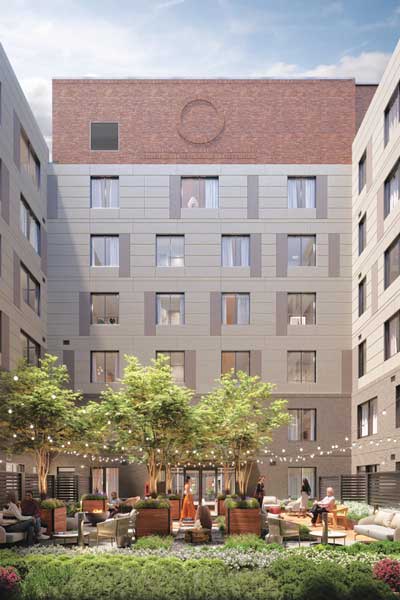
AREP removed an existing skylight to create a six-story open-air atrium and courtyard for residents. American Real Estate Partners
Adaptive reuse projects like CityHouse Old Town resonate with this audience. Each project comes with a distinctive personality shaped by the original building’s architecture. In this case, the structure’s tiered form (reminiscent of a wedding cake), dramatic ceiling heights and interior atrium afforded the design of unique luxury homes that new-build construction could not replicate.
Location adds significant value. Old Town Alexandria is one of the region’s most sought-after suburban-urban communities, celebrated for its walkability, transit access, cultural character, and extensive food and beverage offerings. Its recognition as the second-leading city for office-to-residential conversions in 2022 (behind Los Angeles) underscores the area’s appeal and its readiness for innovative infill projects that emphasize location, character and community enhancement. CityHouse Old Town is a short walk from the King Street public transit station, the Potomac River waterfront and a vibrant mix of restaurants, shops and historic charm, combining neighborhood authenticity with downtown convenience.
The Nuts and Bolts
The transformation of a 141,000-square-foot office building into a 236,000-square-foot multifamily community began with a strategic consolidation of ownership. Over a four-month period in late 2023, AREP acquired all seven units of a previously failed office condo project and negotiated buyouts with eight nonowner office tenants. This move restored the property to single ownership, establishing a clear path for a full-scale adaptive reuse initiative.
While reuse projects are known for their sustainability benefits — preserving core elements can reduce embodied carbon emissions by up to 75% — the scope of work at CityHouse Old Town was still extensive and technically complex.
One of the most significant spatial transformations occurred in the parking structure. Office parking often features sloped floors unsuited for residential uses. Additionally, office buildings require significantly more parking than residential buildings do. At CityHouse Old Town, AREP demolished three levels of an internal sloped parking garage and replaced them with flat residential floors, which required reinforcing the remaining structural columns. This adjustment from 516 parking spaces, 322 of which were compact, to 223 spots added over 100,000 square feet of habitable space while realigning parking capacity to match residential demand.
To address the challenge of deep floor plates that are common in office buildings, AREP introduced short, branching corridors off the main hallways. This design allows access to each home from the center of the floor plate rather than the ends, significantly improving natural light penetration, ventilation and spatial proportions. The result: a more balanced layout that avoids the narrow “bowling alley” configurations typical of office-to-residential conversions.
AREP dramatically expanded the building’s existing central atrium, originally a four-story enclosed space, by removing its skylight. This architectural intervention opened the structure vertically, creating a six-story open-air atrium and courtyard that now serves as a focal point, framed by the building’s interior residences.
The building’s stepped-back facade was reimagined as a series of large private terraces, offering residents ample outdoor living space. On the fourth level, the expansive indoor and outdoor areas overlooking King Street were transformed into a club lounge and terrace. Because the building predates current zoning restrictions, the club terrace provides unobstructed views across Old Town and toward other historic landmarks on the horizon. Additional amenities include a fitness studio, coworking spaces, bike storage, EV charging stations, a dog grooming salon and premium hospitality concierge services.
Delivering its first floors slightly ahead of schedule in late 2025 and remaining on budget, CityHouse Old Town drew interest from more than 600 prospective residents before preleasing began. Originally underwritten in 2022, projected rents have since exceeded expectations, with homes starting at $2,675 a month.
Challenges and Considerations
Bringing an adaptive reuse project to life requires more than vision — it demands regulatory agility; relentless coordination across zoning, architecture, engineering and construction teams; and early alignment on the value proposition for future residents.
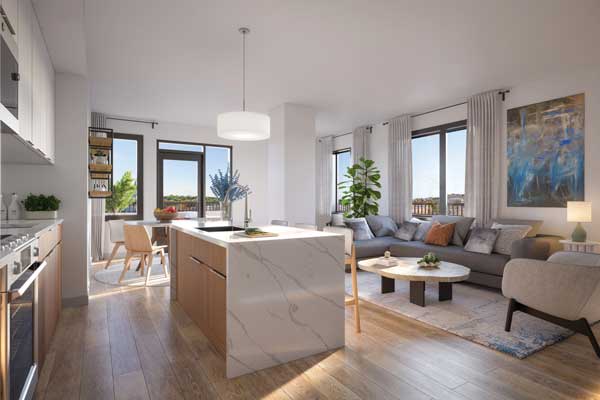
An interior view of one of CityHouse Old Town’s 199 high-end units. American Real Estate Partners
From the outset, AREP focused on understanding municipal processes. Adaptive reuse requires navigating both discretionary and administrative entitlements. Discretionary entitlements include public hearings and community engagement; administrative entitlements ensure compliance with zoning, building and safety codes.
At CityHouse Old Town, these layers of review were compounded by the site’s location in a historic district. AREP worked closely with Alexandria’s Board of Architectural Review to meet preservation standards while aligning the project with the city’s goals to expand housing and revitalize aging assets.
To meet the terms of AREP’s due diligence period, zoning approvals had to move swiftly. The team secured them within six months by proactively engaging the community and addressing concerns around traffic, parking, and building design. Tactics included distributing informational flyers and establishing direct communication channels between the project team and residents. Once construction began, AREP maintained its community commitment, adjusting work hours and mitigating noise to minimize disruption to nearby businesses and residents.
The Big Picture
CityHouse Old Town, which is in the process of being Fitwel certified, underscores both the potential and limitations of adaptive reuse. While often celebrated as a scalable answer to the housing crisis, the reality is more nuanced. Adaptive reuse is time- and capital-intensive, and it is not easily applied to most buildings. Additionally, it requires a location that can support the rent levels to achieve the necessary returns to undertake such a project.
AREP does not see the urban office market returning to its pre-COVID days. Many outdated buildings, particularly those lacking distinctive character or prime locations, may be demolished to make way for new residential projects. These builds will likely target midrise scales given construction economics and site constraints.
The result will be a subtle shift in urban form. Some neighborhoods will lose office worker foot traffic, accelerating retail closures. And while new housing will emerge, it will come at lower densities than the commercial buildings it replaces.
As residents migrate toward suburban-urban neighborhoods that offer walkability, transit access and lifestyle appeal, AREP believes well-positioned adaptive reuse projects will become increasingly important. Adaptive reuse alone won’t solve the housing crisis, but when executed thoughtfully, it represents a powerful strategy for invigorating or revitalizing communities, optimizing the built environment and unlocking long-term value.
R. Mark Taylor is managing director, residential at American Real Estate Partners.
CityHouse Old Town by the Numbers
|