By embedding live music into its urban and commercial DNA, Huntsville, Alabama, turned cultural capital into a magnet for mixed-use investment, private equity and workforce attraction.
In a hypercompetitive market for talent, capital and investment, cities can no longer rely on cheap land or geographic luck to drive economic growth. To attract the next generation of employers and the workforce on which they depend, cities must intentionally build places where people want to be. Huntsville, Alabama, decided a decade ago to center its growth strategy around quality of life and, more specifically, music.
Huntsville used the music industry as an avenue to unlock private capital, catalyze mixed-use development and generate long-term return on investment (ROI) in an erratic commercial real estate environment. It offers a case study in how culture-based infrastructure and complementary programming can serve as a foundation for profitable and sustainable development.
A Sound Investment
Huntsville’s path toward music-led development began with a question: Given Nashville’s popularity, could a second midsize Southern city, with a population of just under 250,000, be a future music destination? To answer that, the city hired Sound Diplomacy to conduct the first municipal music audit in the United States.
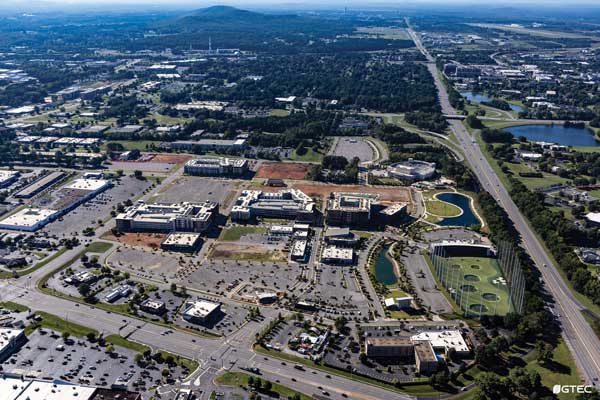
An aerial view of MidCity earlier in the redevelopment process of a 110-acre defunct mall. Marty Sellers, GTEC
Over the course of a year, Sound Diplomacy leadership and staff made multiple trips to Huntsville as part of the study, conducted extensive quantitative and qualitative research and analysis of the city’s specific industry opportunities and needs, and prepared multiple reports to help shape Huntsville’s strategy.
Sound Diplomacy noted Huntsville’s relative proximity to major markets on international touring circuits and suggested its location could incentivize artists to add the city to their regional tours. Beyond geographic advantages, the consultancy found a city with an existing vibrant live music scene, an abundance of music and cultural organizations, and a strong sense of community. As a result, the audit yielded 45 strategic recommendations — chief among them, building performance infrastructure to support a year-round live music economy.
“Music is a medium that attracts — whether it’s jobs, music education or touring acts,” said Huntsville Mayor Tommy Battle.
That strategy became the foundation for what is now MidCity, a 110-acre redevelopment of the defunct Madison Square Mall. Built in 1984, the mall had become a liability by the early 2010s, with just 22% occupancy. After nearly two years of negotiation, acquisition and legal disentanglement from eight separate property owners, the city took a leap of faith. In 2017, it demolished the mall, laying the groundwork for a public-private partnership that would yield financial, social and cultural returns that exceeded expectations.
“Partnering with the city of Huntsville enabled us to transform an underperforming property into a dynamic arts and innovation ecosystem deeply rooted in music and creative industries,” said Max J. Grelier, co-founder of RCP Companies, a real estate owner, operator and developer with offices in Huntsville and Birmingham. “Our nonprofit, the Apollo Coalition, is spearheading ongoing collaborations with the city’s Music Office. This strategic approach has also attracted institutional real estate investors, sparking the potential for additional investment in tech and innovation in Huntsville. At its core, music-driven development at MidCity strategically attracts talent, elevates quality of life and ensures sustained economic vitality for the district and the broader community.”
Financial Fundamentals
Huntsville’s public-private model for the MidCity District was focused entirely on public infrastructure and long-term value creation. The city invested approximately $45 million in infrastructure through roads, utilities, a public park and other public amenities without providing tax abatements or cash incentives to the developer. The city also funded the $55 million Orion, an 8,000-capacity amphitheater now considered one of the premier live music venues in the Southeast and recently named best amphitheater on the East Coast by Billboard.
“We didn’t incentivize apartments or retailers. We invested in music and cultural offerings, and the market responded,” Battle said.
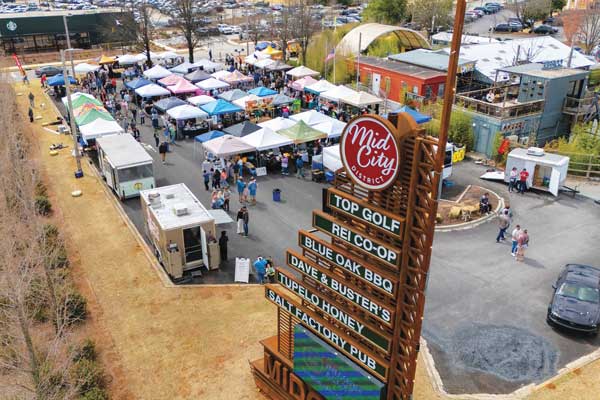
The open-air Market at MidCity, one of the state’s largest, brings extra activity to the district every Sunday from March to November. RCP Companies
Initially, Huntsville modeled $380 million in private return on its investment. That return has already exceeded $480 million, and with more than 60% of the project still to build out, it is now projecting a return closer to $900 million. That includes new property taxes, sales taxes and indirect economic benefits.
The city can offer developers and retailers a high degree of confidence. Two 10-year capital plans — one for economic infrastructure and another for quality-of-life projects such as parks and music — provide transparency, predictability and trust. This helps private partners understand not just what the area is today but what it will become a decade from now.
New major retailers include REI and Trader Joe’s, in addition to entertainment venues Topgolf and Dave & Buster’s, plus multiple hotel and residential projects. The combination of walkability, entertainment and dining has created a district with staying power. For example, every Sunday from March to November, The Market at MidCity is activated with over 50 farmers, bakers, makers and more who gather at one of the largest open-air markets in Alabama.
Programming Makes It Stick
One of the biggest lessons Huntsville learned is that building venues is only half the battle. The other half is programming. The 2018 music audit also led to the creation of the Huntsville Music Office and the nation’s first municipal music officer.
City staff and private partners activated the performance spaces and worked closely to maintain a calendar of events that ensures steady foot traffic, cultural relevance and business viability.
This applies across Huntsville, not just at MidCity. The Mars Music Hall downtown and Butler Green Park each host live music regularly. Huntsville’s Music Office programs a weekly series to ensure that venues are used, not just built. Music has become a calling card for developers who know they are building in a city that can deliver sustained, people-driven interest.
Scaling Citywide: Music as a Catalyst
What started at MidCity District has become a citywide strategy. Developers are integrating live music into their plans from the outset. On the west side, Schrimster Properties repurposed a former elementary school to include a new park and performance space. Downtown, New York-based Essex Capital and partner Silverstein Properties are transforming a former Coca-Cola bottling plant into a $400 million mixed-use live-work-play development with entertainment integrated into the plan.
Huntsville is also seeing growth near the new MLS Next Pro soccer stadium, where Crunkleton Commercial Real Estate Group and its partners are constructing a new $200 million mixed-use project that includes live entertainment as a central feature. Developers increasingly view music and cultural programming as essential anchors in mixed-use environments, not just “nice-to-haves,” said Wesley Crunkleton, a principal at the company.
Over the past decade, these strategies have helped create 46,000 new jobs and attracted more than $7 billion in private investment across the Huntsville community. The music economy remains a crucial component in establishing Huntsville as a “city of preference” for individuals and companies alike.
“The really cool aspect of Huntsville’s emerging music economy is the diversity,” said Matt Mandrella, the city’s music officer. “We are seeing musicians in Huntsville refining their craft in the R&B, country, pop and contemporary Christian sectors.”
Responding to Challenges
The city began work on MidCity District in 2019, with Topgolf promised as the first major tenant and the Orion amphitheater, Apollo Park and a variety of mixed-used developments slated to follow closely thereafter. When the COVID-19 pandemic caused severe disruptions to the development schedule, Huntsville and RCP quickly pivoted.
While retail was on pause, the team focused on advancing public infrastructure improvements throughout the planned district and building multifamily developments that were already in the master plan. This turned out to be a win-win because postpandemic, Huntsville experienced a significant increase in population and needed more available housing across the city.
Huntsville was (and continues) seeing growth of 7,000 to 8,000 new residents per year but was delivering only about 2,300 new residential homes annually. Since 2021, the MidCity District has added 1,043 multifamily units. The pivot allowed the city to quickly respond to multifamily demand while retail demand temporarily slowed. This strategy has allowed population growth to continue while maintaining affordability and quality of life.
As commercial real estate markets evolve, the next competitive edge will come from cities and developers that treat culture and quality of life as primary infrastructure. Whether it’s music, parks or public art, these investments build the environments where people want to live and where capital wants to follow.
Shane Davis is the director of urban development for the city of Huntsville.
Lessons LearnedCultural infrastructure pays off. Music is not just entertainment. It’s economic development. Programming is critical. A venue without a plan is just a building. Activation creates ROI. Public leadership matters. The mayor of Huntsville and the City Council supported this vision consistently, even when the path was uncertain. Flexibility is essential. The development agreement allowed Huntsville to pivot during COVID-19, advancing multifamily while retail paused. Think like a placemaker. Don’t just build for transactions. Build for experiences. |
How the Numbers Stack Up$45M: City infrastructure investment at MidCity. |