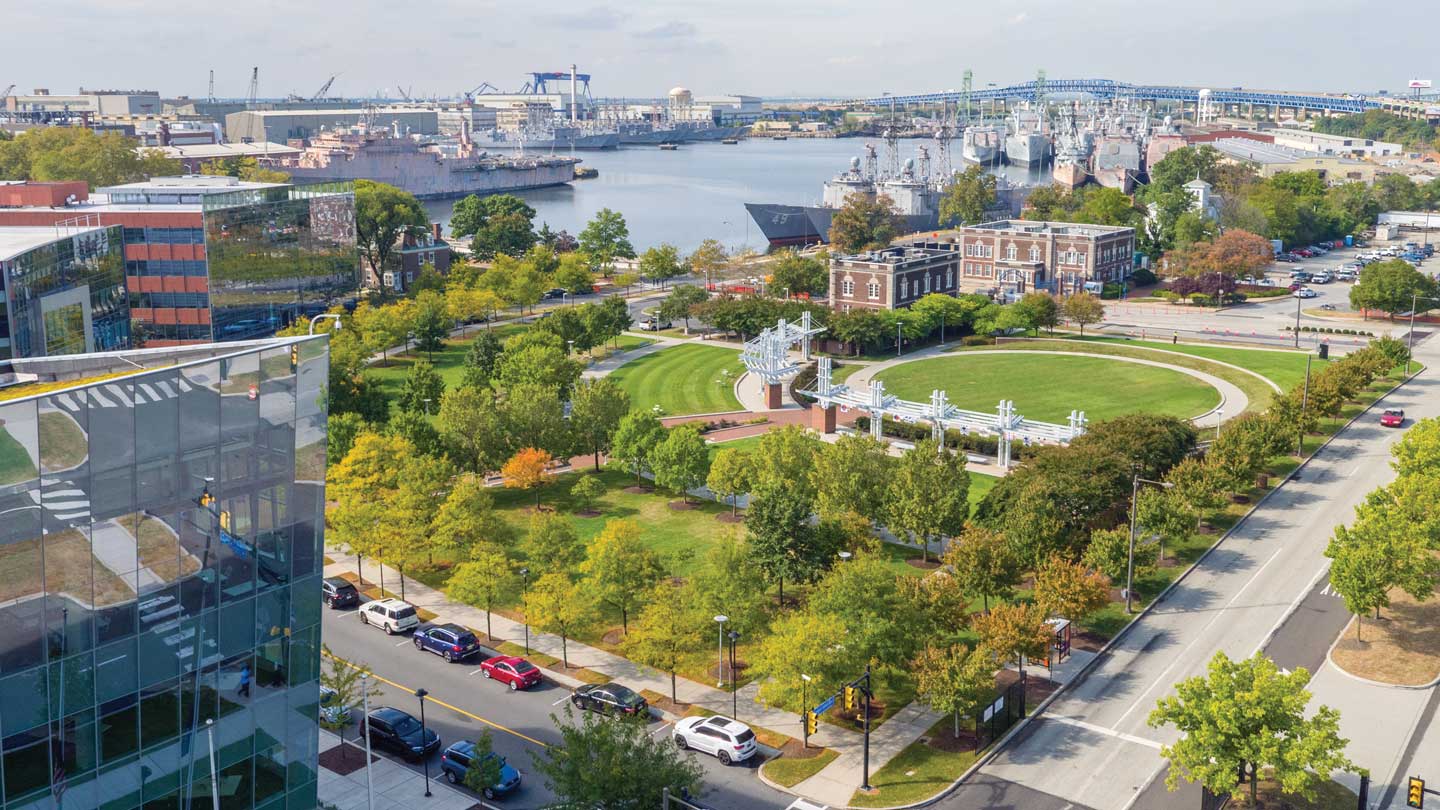
From shuttered shipyard to dynamic business campus to Philadelphia’s newest neighborhood, the Navy Yard’s story is one of continued reinvention.
At the time of its 1996 closure, the Philadelphia Navy Yard employed 2,000 workers, a far cry from its World War II peak, when it produced and repaired more than 1,200 vessels and employed 40,000 workers. A November 1997 Washington Post article described the Navy Yard as a “silent wasteland where a bustling industry once thrived.”
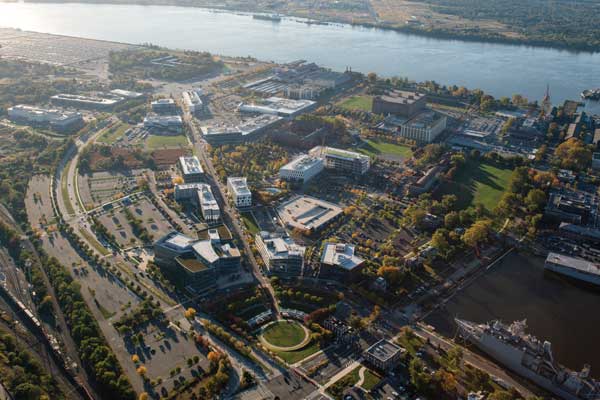
An aerial view of the Navy Yard, with the Delaware River as a backdrop. Courtesy of Ensemble Investments
City officials determined to keep the ship(yard) afloat, however. The Philadelphia Industrial Development Corporation (PIDC), the city’s public-private economic development corporation, was tapped to oversee the Navy Yard’s development.
When the naval base closed, the city and PIDC “saw not just vacant land, but extraordinary potential,” said Kate McNamara, executive vice president of the Navy Yard for PIDC. She noted the site’s proximity to Philadelphia International Airport and the city’s downtown, as well as its convenient location between New York City and Washington, D.C.
“We stepped in with a vision to transform the Navy Yard into a dynamic business campus that could create thousands of jobs, attract private investment, and generate significant revenue and long-term economic growth for the city and commonwealth,” McNamara said. “Today, it is an economic powerhouse for the Philadelphia region, with $2.8 billion in public and private investment.”
Ensemble Investments, a commercial real estate investment firm founded in 1989, and its partner, Mosaic Development Partners, are now piloting the entire site’s development while controlling 109 acres. Their work has been recognized as a leading model for repurposing military and industrial assets for a diversified modern economy.
Ensemble/Mosaic’s marketing materials for the 1,200-acre Navy Yard site call for development of a 24/7 “Live, Work, Play, Stay, Breathe” community. In reality, that means creating a campus, built with $6 billion in investment, for an anticipated 30,000 permanent workers and 6,000 to 8,000 residents when the development plan is completed in approximately 20 years.
Teaming Up for Greater Impact
West Coast-based Ensemble’s path to becoming the primary developer with Mosaic began in 2014 when it developed a Courtyard by Marriott with 212 guest rooms and suites, 2,000 square feet of meeting space and a business center at the Navy Yard. “A lot of the local Philadelphia developers and regional developers saw the Navy Yard as an extension of the airport submarket. They didn’t fully buy into the [overall] vision. … Ensemble understood the vision and the potential,” said Brian Cohen, who along with fellow managing director Mark Seltzer is responsible for Ensemble’s East Coast developments and investments.
“Because Ensemble is truly a mixed-use developer and had done office, residential and hotel, it saw a unique opportunity to take its experience in all of those different product types and leverage it in one location as part of one planned development,” Cohen said.
Ensemble and Mosaic, a Philadelphia development company devoted to making a positive economic impact in the communities where it develops, were familiar with each other’s work through local real estate circles. They decided to join forces because both companies recognized “there was imbalance in equity within the commercial real estate space,” said Leslie Smallwood-Lewis, a founder and chief operating officer of Mosaic. “What we have found is that if you are not coming with that lens and that sensitivity, sometimes things get missed.”
On that front, Smallwood-Lewis noted the involvement of Basis Investment Group, a certified minority- and women-owned business specializing in diversified commercial real estate investments. Basis brought in a portion of the equity for the Navy Yard’s first residential project, AVE Navy Yard, which includes Chapel Plaza. The recently opened plaza is a signature 35,000-square-foot public space featuring dining, lounge areas and performance spaces.
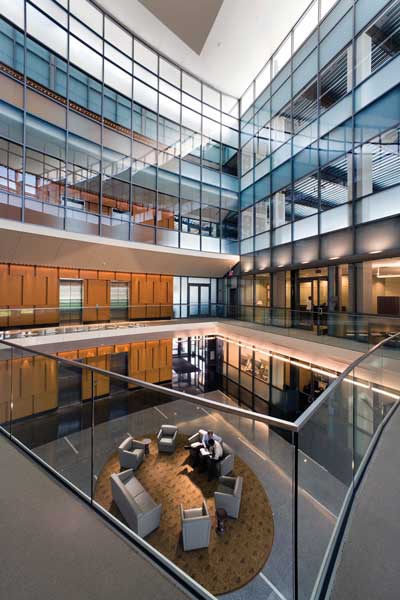
One Crescent Drive was the first new privately developed office building in the Navy Yard’s Corporate Center and the region’s first LEED Platinum office building. It comprises 76,000 square feet of space around a central indoor atrium. Courtesy of Ensemble Investments
The project’s minority participation is “setting the bar even higher, not just for our projects but for other projects,” Smallwood-Lewis said.
Together, Ensemble and Mosaic put together what they termed an “impact strategy.” Among the goals were devising a comprehensive approach to equity for minority- and women-owned businesses; designating a portion of the residential units for affordable housing; developing in a highly sustainable manner; and supporting a well-trained workforce to meet the current and future needs of Navy Yard employers.
“Economic development is not just about building buildings but creating jobs,” Seltzer said. “We created an impact strategy not only to help diverse companies but to help small businesses grow. The idea here is to create jobs and create small businesses to allow our city to thrive.”
Sustainability is another component of the impact strategy. From the start, the Ensemble/Mosaic team was guided by standards set by the U.S. Green Building Council. In April 2025, the Navy Yard achieved LEED Gold certification for neighborhood development, making it the largest such project in the country.
Ensemble/Mosaic also engaged a firm that specializes in resiliency to ensure the Navy Yard is prepared to handle rising sea levels 75 years into the future. After all, the site was originally an island, sitting at the confluence of the Delaware and Schuylkill rivers. Ensemble/Mosaic raised vulnerable portions of the site, including elevating buildings and infrastructure, and used dry ponds, green roofs, and resilient landscaping and trees to mitigate the impact of climate change and prevent flooding in the new community. Future plans involve incorporating innovative infrastructure, including canals and swales along the streets on the east side of the campus, to convey stormwater.
What’s Now and What’s Next
According to McNamara, the Navy Yard is currently home to more than 16,000 employees and 150 employers. They occupy more than 8 million square feet of facilities across a mix of property types, including life sciences, health care, advanced manufacturing, creative industries, technology, and research and development. Navy Yard employees occupy roles ranging from office workers and lab technicians to designers and welders.
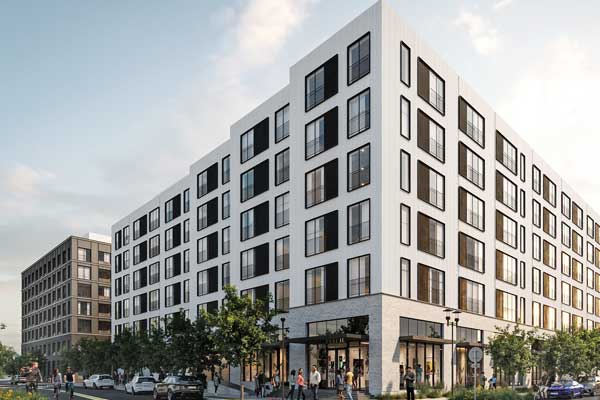
The Chapel Block complex includes a seven-story building and two connected six-story buildings. As the Navy Yard’s first residential complex, it offers over 600 luxury and mixed-income apartments. It will also include 75,000 square feet of resident amenity space and 25,000 square feet of retail/restaurant space. Courtesy of Digsau
In November, Ensemble/Mosaic, in partnership with Korman Communities, a real estate company with 40 properties throughout the United States and London, opened the first residential housing in the Navy Yard. Two midrise apartment buildings offer 614 studio, one-, two- and three-bedroom apartments and 25,000 square feet of retail.
Joining the Navy Yard’s growing amenities across the street from the residential buildings will be Happy Bear Coffee Company, which has signed a lease for 3,036 square feet. The cafe will combine specialty coffee, a wine bar and chef-inspired casual grab-and-go food from its culinary partner, Carlino’s Specialty Food. The shop is on the first floor of 1201 Normandy Place, a multitenant lab building. The space will offer outdoor seating on Triangle Plaza and is next to two additional public spaces, Central Green, an award-winning 5-acre park, and Chapel Plaza.
The Navy Yard has more than 10,000 parking spaces for residents and workers. Additionally, a robust shuttle program offers employees and visitors easy access to the Navy Yard from Center City and public transportation.
A Gradual Transformation
The “overnight success” of the Navy Yard was no sure thing following the base closure.
In 2000, PIDC acquired the site from the Navy on behalf of the city of Philadelphia. The plan at the time was to create a business campus. Because of deed restrictions placed by the Navy, any consideration of residential was far in the future.
Liberty Property Trust and Synterra Partners won the rights to develop the site. Their 2004 plan was more practical than inspirational.
“At that point,” Cohen said, “there was no new development at the Navy Yard. … [The site] was seen as an opportunity to compete with a [walkable] suburban corporate campus.” That meant low- to midrise office buildings with parking. The idea was to draw companies from the suburbs into the city while discouraging city-based companies from departing, he said.
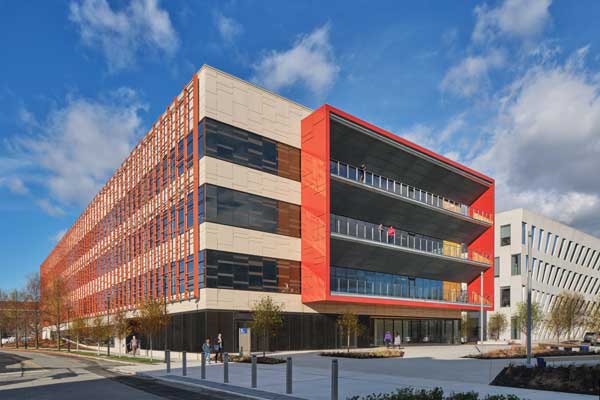
1201 Normandy is optimized for research and development companies engaged in cell and gene therapy, but its 137,000 square feet of space were built with flexibility to accommodate all types of life science tenants. Courtesy of Ensemble Investments
Commercial activity at the time was concentrated in a few areas rather than being spread over the site’s 1,200 acres. In 2005, two new properties were completed, one a multitenant speculative building with a small medical lease and the other a build-to-suit. Combined, they had approximately 350 workers. In addition, the Navy maintained a presence at the yard with its Naval Ship Systems Engineering Station, the Naval Foundry and Propeller Center, and the Naval Inactive Ship Maintenance Facility. A handful of existing structures originally built by the government were occupied by companies not associated with the Navy. There were no amenities and limited infrastructure.
Even so, in 2006 the site received a confidence-boosting proof of concept that it could draw companies to the atypical setting when lifestyle retailer Urban Outfitters moved its headquarters from Philadelphia’s Center City. Initially, 500 people began working at the site. The company now employs about 3,000 people across its corporate campus of 16 buildings totaling 667,872 square feet, with each of its consumer brands having its own building.
“There are several other examples now in office, life sciences and manufacturing where CEOs were able to come out of suburban Philadelphia or Center City or from out of market and create their own campuses within the Navy Yard with signage, branding and unparalleled control of culture, processes and efficiency,” Seltzer said.
Focusing on market demand, Liberty/Synterra and PIDC initiated a new plan in 2012 that called for four-story office buildings measuring 60,000 to 80,000 square feet that could be speculative or build-to-suits. Not everything in that plan panned out, such as the idea to build distribution centers.
“The vision for this area was always to take advantage of a large land parcel to create large-footprint buildings, as Philadelphia has a dearth of sites in a mixed-use campus environment to accommodate those uses. And with the Navy Yard having access to the highways, airport and [surrounding] population, it was seen as a potential opportunity,” Seltzer said. “However, with the costs to prepare pad-ready sites, it did not make economic sense to do one-story distribution centers. With Ensemble/Mosaic’s 2022 plan, we still envision larger-footprint buildings than you can find in other areas of Philadelphia. We continue to target life sciences and advanced manufacturing but have the flexibility to attract other sectors like the office market as that becomes an area of growth.”
Seltzer said the current site’s success is due in part to Ensemble/Mosaic’s ability to adapt. “The needs of the market and our tenants are going to change,” he said. “AI is coming into the workplace and it’s affecting life sciences. What an office means to people and how they are using it is changing. We understand all those things are going to change. With the transformation of the Navy Yard into a mixed-use community, we wanted a flexible plan, and I think that’s what we’ve done. We’re building for the future.”
Ensemble Takes the Lead
In 2019, Liberty and Synterra, which had developed 1.5 million square feet at the Navy Yard, relinquished their development rights, as Liberty decided to focus on industrial real estate.
By that time, Ensemble had acquired another $360 million in office buildings and labs across 60 acres at the Navy Yard. Recognizing the site’s ongoing possibilities, Ensemble was eager to be a part of its future. Both Cohen and Seltzer had spent years evangelizing about the Navy Yard’s potential while working for Liberty and implementing its blueprint. They decided to join Ensemble to lead its development proposal. In 2020, Ensemble/Mosaic beat out more than 30 other bidders, including large national developers, for the rights to develop 109 acres at the Navy Yard.
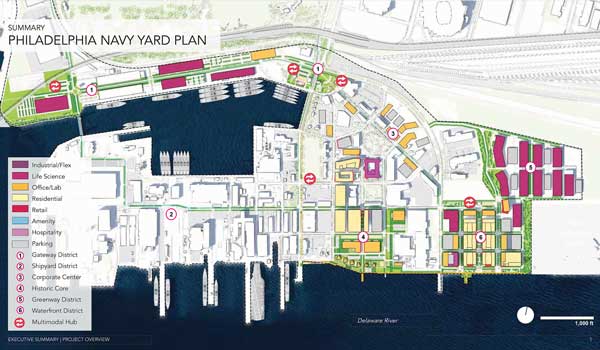
James Corner Field Operations
Importantly, those rights included the opportunity to develop residential apartments, with the former deed restriction being lifted in 2023 after years of negotiations between the Navy and PIDC. Until its 1996 closure, the Navy Yard had provided different types of housing for its personnel and their families, including homes for admirals and other officers, enlisted family housing for married enlisted personnel and their families, and barracks to house single enlisted service members.
Ensemble estimated the cost for its initial phase of development at approximately $500 million. This includes development of a 670-space parking garage with 11,882 square feet of ground floor retail; mixed-use multifamily buildings in partnership with Korman; and a 223-room luxury hotel, The Waylen, that will be part of the Unbound Collection by Hyatt.
As one of the first undertakings of the new master plan, Ensemble/Mosaic also built a $100 million, four-story, 137,000-square-foot state-of-the-art lab building on spec. Two tenants currently occupy the building: bioMérieux, a global leader in the field of in vitro diagnostics, and a robotics company.
Life sciences and advanced manufacturing emerged organically as sectors at the Navy Yard in the early 2000s. In 2004, Liberty/Synterra developed an approximately 75,000-square-foot building for AppTec, a global contract research, development and manufacturing organization. The company, which was acquired by Minaris Regenerative Medicine, has since expanded three times and occupies approximately 400,000 square feet in four different buildings.
In May, Pennsylvania announced a $30 million grant to fund utility infrastructure, soil excavation, grading and stormwater management to develop the Greenway District, an advanced manufacturing and life sciences district at the
Navy Yard.
Developing With a Wider Scope
While Liberty/Synterra’s emphasis had been on creating a suburban-style corporate campus, Cohen said Ensemble/Mosaic’s plan began with a much different question given knowledge of the ongoing negotiations to lift the Navy Yard’s residential restriction: “How do we create Philadelphia’s newest neighborhood?”
“We had to give real thought to how residential was going to be incorporated,” Cohen said. “We had to think how each of these uses could be complementary to each other. … Where should retail be placed so that both the daytime employees and the residents can benefit from that retail? Ultimately, what we ended up with was a lot more density but also thinking about placemaking [and] how parks will be used by employees and residents. And how do we do this in the most sustainable way?”
Added Smallwood-Lewis, “Our vision for the Navy Yard balances growth with preservation — keeping the parks, the waterfront and the natural beauty intact so that residents and visitors can continue to enjoy its openness.”
“In most instances as a developer, you’re looking at the block that you own and what you are going to develop on that block,” Cohen said. “You’re thinking about the surrounding blocks and how does your project relate to that. But in this instance, developing 109 acres within a historic site is a generational opportunity. You don’t think about it building by building. You’re thinking about what this place is going to be for the millions of people who are going to interact with it for decades to come.”
Jay Nachman is a communications consultant who provides services to clients in greater Philadelphia and beyond.
America’s Coolest ShipyardIn a July 2016 article, Politico called the Philadelphia Navy Yard “the coolest shipyard in America.” In the nearly 10 years since, the site has only gotten “cooler,” adding multiple new buildings, thousands of new workers and various public art installations. Last April, the Navy Yard was recognized as the nation’s largest LEED neighborhood development, affirming the project team’s commitment to health and wellness, sustainability, walkability and public green space. The site offers more than 20 acres of green space, including Central Green, a 5-acre park featuring a running track, hammock grove, bocce courts and an outdoor meeting table, and Riverfront Greenway, a scenic 1-mile path along the Delaware River. In addition, the Navy Yard is a certified arboretum, one of just six in Philadelphia, and home to more than 2,000 trees, historic plantings, and an array of birds and wildlife. The Navy Yard also hosts more than 100 free events annually, including seasonal festivals and outdoor art installations, fitness classes, a weekly running club, recreational sports leagues, dog-friendly gatherings, composting workshops, food truck lineups and apiary tours. Visitors can enjoy historic architecture and docked naval ships that recall the site’s legacy as a U.S. naval shipbuilding powerhouse. The Navy Yard’s public arts projects have included critically acclaimed installations by local and international artists. In November, the Navy Yard welcomed its first-ever civilian residents to two newly constructed apartment buildings. Residential amenities include a pool and sundeck; gaming lounges with billiards, video games, card tables and a golf simulator; a 24/7 fitness center with top-of-the-line equipment and seven individual fitness pods; a soundproof recording studio for podcasting and music; a pet spa; and Zen courtyards with firepits, grilling stations and lounges. Cool indeed. |