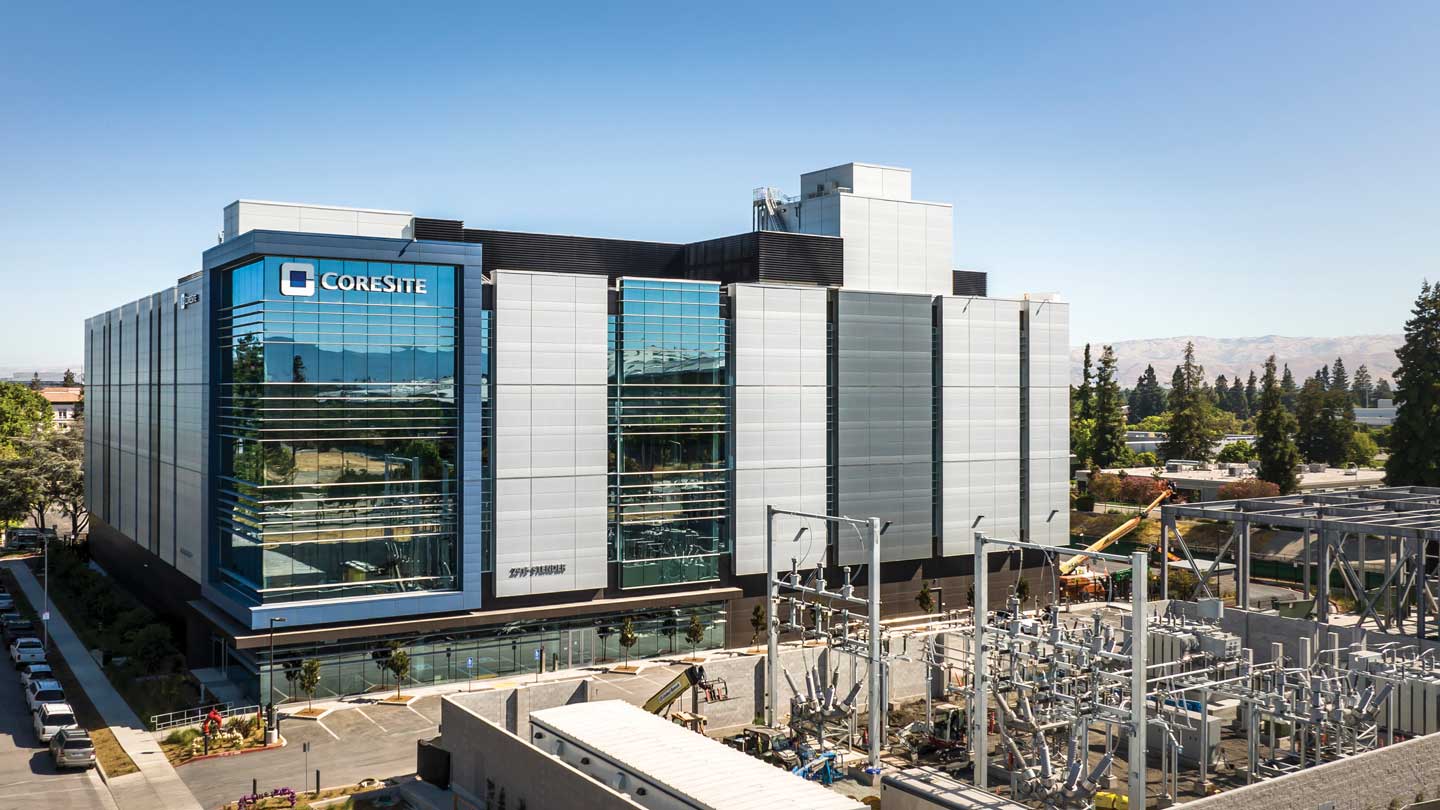
As grid expansion lags, developers and investors are rewriting the development playbook around energy.
Today’s commercial real estate conversations are inevitably turning to talk of power and how to attain it. For many industry players, electricity — not land, zoning or entitlements — is the ultimate constraint. Power delivery, once measured in months, is now calculated in years, according to industry sources.
A September forecast from S&P Global reported that year-over-year power demand from U.S. data centers was expected to rise 22% by the end of 2025 and to nearly triple by 2030 compared with 2024 levels. But data centers aren’t the only commercial real estate with big power needs. Many other high-load users are also waiting in line.
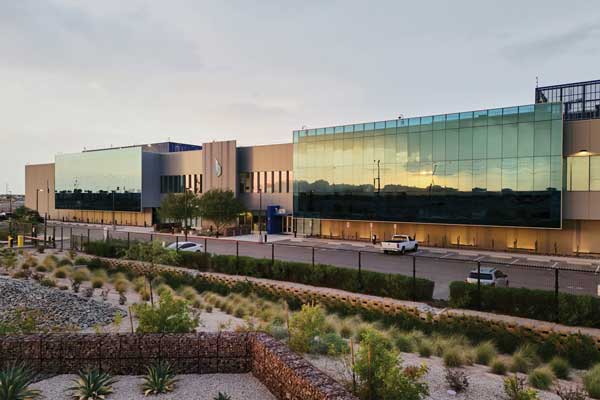
The Vantage Data Centers AZ1 campus in Goodyear, Arizona, will have a combined capacity of 176 megawatts. Courtesy of Corgan
From electric vehicle (EV) charging depots and battery plants to cold storage warehouses and ports, the development cycle increasingly revolves around electricity and when it will become available. Take retail EV charging stations, for example. While actual physical construction may take a matter of months, the time from first utility engagement to final energization can drag on for as long as two years, according to SparkCharge, a company that specializes in mobile charging services for EVs. Service connection studies, transformer procurement and distribution feeder upgrades are delaying fleet depot and multifamily charging projects across multiple states.
Industrial and manufacturing users are feeling the same pressure. Power sector consulting firm Grid Strategies estimates that nationwide five-year load forecasts have surged fivefold, largely driven by semiconductor, EV and battery plant construction. Utilities in states such as Arizona, Ohio and Tennessee currently warn that interconnection queues and transformer shortages could postpone new factories for years — an echo of what data centers are facing in Northern Virginia.
Meanwhile, cold storage warehouses — among the most power-intensive industrial uses — are running up against substation and equipment backlogs that can add a year or more to delivery schedules, according to Cushman & Wakefield’s 2024 outlook. Ports and intermodal facilities are also facing a tight energy future. Even asset classes such as multifamily, mixed use, office and life sciences that require lower electrical loads are feeling the pinch. In these cases, the strain is less about megawatts and more about local capacity, panel upgrades and transformer availability.
An Extending Power Timeline
“Power is king,” asserted Davis Griffin, managing director of Trammell Crow Company’s Strategic Development Solutions Group. “For the groups we’re working with, the timeline to first power — whether 18, 24 or 36 months — drives everything. In many locations, power may be five years or more out.
“The reality is that demand for power continues to grow much faster than supply. In most primary data center markets, power requests now exceed available capacity by two to three times. As a result, power has become the gating issue. Of course, entitlements, labor, water and other elements are still fundamental.”
According to those interviewed, the quest for power is reshaping the way developers plan, design and finance commercial real estate projects. In many instances, a parcel’s value might be related less to geography or zoning and more to its position in the grid.
“Everyone has the best intentions,” said Pat Lynch, executive managing director for CBRE Data Center Solutions, “but the technology industry’s speed-to-market needs are very different from the utility sector’s timelines. We often need power today, while utilities are planning five to 10 years out. That’s the core disconnect.”
Data Centers Dynamics
Data centers lead demand for electricity in commercial real estate by a wide margin. “Data centers are becoming a much larger consumer of power in the U.S.,” said Carrington Brown, senior managing director of development at institutional investment firm Affinius Capital. “A few years ago, they used maybe 3% to 4% of total U.S. energy consumption. Today, that percentage is closer to 6% to 7%, and by 2030, reports suggest it could reach as high as 12%.”
In many markets, generation capacity is the issue, “but a lot of the real challenges are with transmission and transmission upgrades,” Brown added. “When you have huge volumes of power being consumed by data centers, it has to be transmitted from the generation source to the user. Those upgrades take a lot of time — not only engineering and construction but also securing easements and rights of way, which can face opposition.”
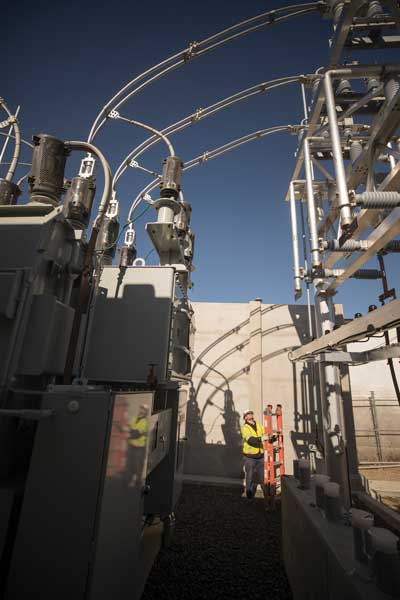
Power transmission upgrades can be a challenge on par with generation capacity in some markets. Courtesy of National Grid
Right-of-way battles in particular can add years to the transmission process. The U.S. Department of Energy estimated that adding a major new line can take eight to 12 years from proposal to energization. For industries like commercial real estate development, that is an eternity and, often, a deal-breaker. According to Grid Strategies, only 322 miles of new high-voltage transmission lines were completed in 2024, the third-slowest year of new construction for 345-kilovolt and above transmission over the past 15 years. A kilovolt is equal to 1,000 volts.
Gridlock in Core Markets
No area demonstrates this tension more vividly than Northern Virginia, easily the world’s top data center market measured by capacity. “There’s no question that parts of Northern Virginia are gridlocked today,” Griffin said. “Power and entitlements are a real challenge. But the market isn’t standing still. We’re now seeing expansion south toward Richmond and north into Maryland as utilities invest in new transmission and as users chase available power and entitled land.”
Nate Kirschner, branch manager at Bohler Engineering, an engineering firm with numerous commercial real estate clients, has witnessed the same problem. “Some of our clients have told us that they will not get power until 2027,” he said. “In some instances, utilities are projecting power delivery timelines extending as far as 2029. Nevertheless, clients across multiple sectors — including retail, industrial, not solely data centers — continue to pursue land acquisitions and welcome [electric] load letters aligned with those extended timelines.”
These commitments provide valuable lead time to address current development challenges, according to Kirschner. What was once considered short term is now defined as a horizon of two years or more. “We’re observing heightened activity across a wide range of markets, including geographies that until recently were not considered viable data center locations but are now emerging as significant hubs,” he said.
Power First
The order of development seems to have flipped in recent years. It used to be that a developer found the right parcel and then negotiated energy delivery. Now, it’s the opposite: The power comes first and the land follows.
“Securing power first makes perfect sense,” Griffin observed, “but in practice, it’s not always feasible. Most utilities can’t or won’t study an entire area; they want a specific site tied to a substation or circuit before they complete a power study. And many utilities require proof that you own or control that land before they will even begin. We often have to move on both fronts simultaneously — securing the right site while advancing conversations with the utility in parallel.”
That chicken-and-egg dilemma has given rise to a new discipline in commercial real estate: energy-forward development. In this model, site planners, engineers and utility specialists collaborate from day one, integrating power planning into every design and entitlement decision. Deals now depend on who can move electrons fastest, not just who can move the dirt.
Grid Determines Design
The scarcity of power-capable sites is reshaping the physical form of projects. When access to a substation or high-capacity feeder determines feasibility, developers are rethinking how to extract every possible square foot from a parcel that already has power.
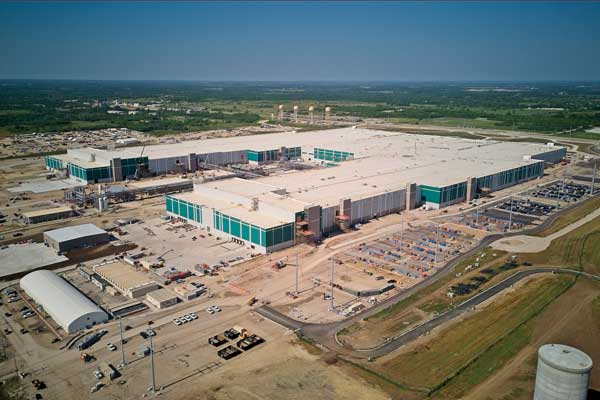
An aerial view of the 300-acre Panasonic battery manufacturing facility at Astra Enterprise Park in DeSoto, Kansas. Ryan Wewers via iStock Editorial/Getty Images Plus
Kirschner described the shift: “From a development standpoint, the projects we’re tackling today are truly atypical. Traditionally, you focus on value-engineering — those ways to cut costs. Now, land with access to power is so scarce, and the upside so significant, that developers will say, ‘We’ll spend $2 million on a retaining wall if it gets us 20,000 more square feet of space.’ It’s a no-brainer.
“The next question usually is: ‘What if we double the height of the retaining wall? How many square feet extra can we get now?’ The mindset has shifted from trimming costs to maximizing footprint. For designers trained to squeeze out expenses, the new challenge is: ‘How can we make the building bigger?’”
That shift mirrors what’s happening in the utility sector itself, where grid constraints have turned engineering from optimization to triage that is prioritizing projects that are furthest along or have firm power-purchase agreements.
New Markets Rising
As legacy hubs run out of capacity, developers are fanning across the map in search of fresh power and friendlier permitting. Kirschner sees movement “in the Midwest, the Southeast and the northern Plains — markets like Louisiana, North and South Dakota, Kansas.” These locations, once off the data center radar, now hold appeal precisely because they aren’t crowded. “Communities that want these projects are getting creative in providing support,” he said. “They see the tax base and career opportunities.”
Lynch agreed that the center of gravity is shifting. “That’s why you’re seeing projects in places like Louisiana, Pennsylvania and Alabama — locations we wouldn’t have imagined five years ago.”
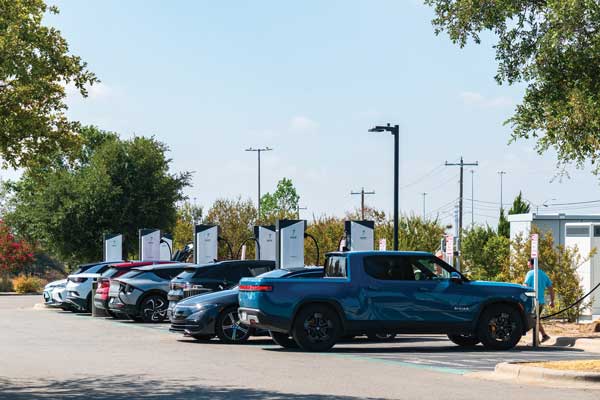
The process for getting an EV charging station up and running can take as long as two years. RoschetzkylstockPhoto via iStock Editorial/Getty Images Plus
Secondary markets like Tulsa, Oklahoma; Columbus, Ohio; and Hillsboro, Oregon, are also emerging as fast-growth nodes. According to reports from CBRE and JLL, many of these areas have become national leaders precisely because they can still deliver power in less than two years — a competitive edge that’s disappearing elsewhere.
The Substation Squeeze
Even when a utility approves new service, the local substation can become a choke point. “You would be hard-pressed to acquire a greenfield site and be operational in under two years,” Brown said. “Substations require long-lead equipment, and those transformers are in short supply.”
According to global research and consultancy group Wood Mackenzie, large transformer delivery times now average 24 to 36 months, driven by steel shortages and global demand. Power transformers and distribution transformers faced supply deficits of 30% and 10%, respectively, in 2025.
In addition, local opposition to a new project, particularly large data centers, can add another year or two. The result: Power may be “committed” on paper, but it can’t be delivered in practice.
Looking Beyond the Utility
Faced with multiyear grid delays, the industry is exploring on-site generation and behind-the-meter solutions, although industry practitioners expect grid-connected projects to remain the favored choice, according to Boston Consulting Group. As Brown explained, “On-site generation will become a much larger piece to data centers because many states are passing laws requiring demand response. When the grid is maxed out — hot summer days, cold winters — utilities can scale back your allocation. On-site generation may be the only way to keep a data center running 24/7.”
Options currently gaining traction include:
- Microgrids and battery storage systems combining renewables and gas turbines.
- Natural-gas-powered turbines that provide continuous baseline power.
- Small modular nuclear reactors.
- Corporate renewable power purchase agreements and off-grid solutions, often in partnership with regional utilities.
Griffin noted these solutions come in many forms, and all have pros and cons. There is also the question of whether they are simply bridge solutions until the grid catches up or part of the long-term power strategy for specific sites.
Lynch added that reliability remains nonnegotiable: “End users expect 100% uptime. That makes it difficult to rely heavily on intermittent renewables like wind or solar, especially on the scale we need. Nuclear power is one of the most promising solutions.”
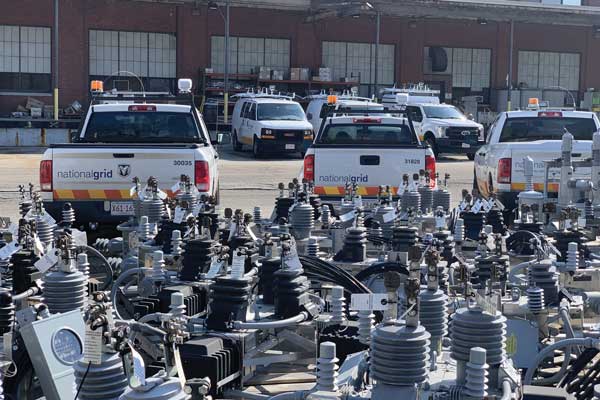
“National Grid is committed to advancing economic development, and we recognize the essential role we play in supporting commercial real estate growth across our service territories,” said Morgan Steacy, vice president of connections and strategic accounts for utility company National Grid. “Addressing speed-to-power challenges is a priority across the country, and we are leveraging innovative technologies, processes and software to accelerate connections efficiently.” Courtesy of National Grid
According to JLL’s 2025 Global Data Center Outlook, nuclear power is rapidly gaining traction as a practical and low-carbon solution to meet the surging energy needs of data centers — particularly those supporting AI and high-performance computing. With technology companies driving massive new power demand and simultaneously pursuing some of the most ambitious net-zero commitments in the corporate world, nuclear energy offers a way to satisfy both imperatives: reliability and sustainability.
Financing
The energy bottleneck may be changing project financing. Developers now need not only strong engineering but also strong balance sheets. Utilities are demanding letters of credit, financial guarantees and detailed load profiles before allocating capacity.
“The capital markets are healthy,” Brown said. “There’s a diverse pool of financial parties — traditional banks, life insurance companies, debt funds, project and infrastructure finance. We’ve seen IPOs [initial public offerings], large acquisitions and major institutional investors entering the space. When you lend or invest in data centers, you’re helping to capitalize essential and critical infrastructure being led by some of the best credits in the world.”
However, for newer or smaller AI companies, the barriers are high. As Lynch noted: “Many emerging AI or neocloud firms are backed by private equity and don’t have the credit under which these deals can be underwritten. We advise our clients to engage at least three years in advance to address their future data center needs.”
The Next Decade: CRE in the Age of Power Scarcity
Looking ahead, the consensus among experts is clear: The next decade will reward developers that treat energy as the first design variable.
Data centers already account for a significant share of the nation’s electricity use, and that share will increase dramatically by 2030. With the grid near capacity, Kirschner said, “people will need to get creative. Secondary and tertiary markets will become a bigger focus.”
Lynch said the “AI wave” will push computing closer to major cities, and those edge locations will bring new constraints. He cautioned that “the next wave, inference-based AI, will need to be closer to population centers like Los Angeles and New York. The aggregate demand for power will grow, even if individual facilities are smaller.”
In short, the grid isn’t broken, but it is out of sync with the speed of modern commercial real estate development. Utilities plan decades ahead; the tech and CRE industries move in quarters. Until that mismatch narrows, power will remain the defining constraint on real estate’s most ambitious projects.
Ron Derven is a contributing editor to Development magazine.
ABC of the U.S. Electric GridThe U.S. power grid isn’t a single system; it’s three semiconnected networks: the Eastern Interconnection, the Western Interconnection, and ERCOT in Texas. Together, they move electricity over 700,000 miles of high-voltage lines owned by hundreds of separate utilities. That patchwork design, born of state regulation and regional monopolies, makes expansion a bureaucratic marathon because projects must clear:
|
Why Electric Substations Take So Long to BuildSubstations convert high-voltage power to lower voltages that end users can use. They’re vital but also painfully slow to deploy because:
The Electric Power Research Institute reported that some users now wait three years just for parts. Even after equipment arrives, commissioning requires utility coordination that can take months. For developers, it’s one more bottleneck. |
Developers’ Playbook: Keep Your Friends Close and Your Utility CloserThe most successful developers think like utilities — mapping, financing and reserving electrons years before breaking ground. Power is no longer an afterthought; it’s the first entitlement, according to experts. Here are some tips for potentially cutting lead times:
|
Small Modular ReactorsSmall modular reactors (SMRs) have moved well beyond the concept stage, with the Nuclear Regulatory Commission already having licensed several designs, including NuScale Power’s 77-megawatt-electric reactor design. SMRs are compact, factory-built nuclear power units designed to deliver low-carbon, always-on electricity at a fraction of the scale of a large nuclear power plant. If SMRs move into broad use, they could solve a lot of problems for data center developers by supplying their own power instead of tapping into the local utility’s power supply. Advocates cite faster construction, improved safety systems and flexible siting near industrial or microgrid locations. However, costs, waste handling and regulatory hurdles remain significant challenges, so commercial deployment is unlikely before late this decade. |