Designers, developers and property managers have sharpened strategies for creating connections.
More than five years ago, individuals, businesses and jurisdictions were coming to the realization that shutdowns would be a longer-term response to COVID-19 than originally anticipated. While that era of restriction eventually passed, some of the pivots driven by the pandemic conditions have resulted in enduring impacts on commercial real estate.
Earlier in 2025, several design, development and property management experts responded to questions from real estate public relations firm Taylor Johnson about the pandemic’s longer-term effects on multifamily and office.
When it comes to amenities, how did the pandemic impact what residents are looking for in apartments?
Diana Pittro, executive vice president, RMK Management Corp.: Today, our communities offer more remote work areas and in a variety of forms, depending on residents’ needs. Options include private pod rooms, booths, Zoom and podcast rooms, workspaces with relaxing views, and small and large conference rooms to accommodate groups. Our sister company, M&R Development, in recent years has built new communities with an increased number of these workspaces. For existing properties that we manage, we have repurposed spaces that were underutilized during the pandemic, such as theater rooms, to create these work areas.
For our city properties, the remote work areas are just as popular today as they were a year ago, but many of those residents are interns and students attending college downtown. In more suburban areas, we have seen a slight decline in the use of these workspaces due to the return-to-office push, but the spaces are still heavily used and popular.
In addition to creating more spaces and seating areas for residents to socialize inside the building, we’ve responded by providing outdoor areas where they can relax and meet neighbors. At some properties, we repurposed outdoor tennis courts and indoor racquetball courts into pickleball courts, which have soared in popularity. For properties with basketball and pickleball courts, holding tournaments around these sports has become a hit with residents.
Brad Lutz, multifamily practice leader, Baker Barrios Architects: Coworking spaces have gone from “nice to have” to a must-have amenity that needs to offer high-end tech features and fast Wi-Fi. Baker Barrios often brings in our director of workplace strategies, Marilyn Russell, to assist in designing the coworking spaces of multifamily projects to ensure the environment is equal to, if not better than, in-person work.
Desire for spending time outdoors is another carryover from pandemic days. Clients want us to incorporate direct outdoor access for amenities, such as gyms with retractable window walls that open to a green roof for fitness classes, and coworking spaces that have an adjacent terrace equipped for productivity, with flexible seating, ample outlets and a strong Wi-Fi signal.
How have multifamily communities adapted to the demand for face-to-face interaction in a post-social-distancing era? How do you foster desired resident connections?
Pittro: We have seen a return to the desire for more face-to-face interaction among residents and our on-site staff. We first offered the opportunity for in-person meetings for things like lease renewals, and many residents were on board. Now we have returned to handling nearly all our traditional resident interactions in-person, although some residents still appreciate the option of a virtual meeting due to their schedules. During the pandemic, residents began to file virtual maintenance work orders, and this practice has continued at many communities, and our teams follow up on all work orders to be sure they are completed. While much of this communication is through phone calls, these contacts provide important touchpoints to cultivate relationships with residents.
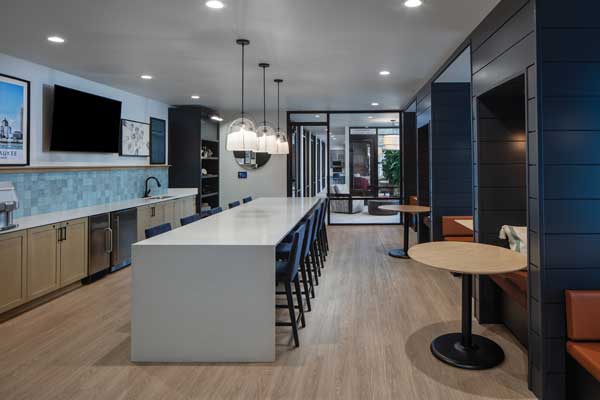
The coffee bar and flexible remote workspace at 2929 on Mayfair in Wauwatosa, Wisconsin. RMK Management Corp.
Renters today also seek a sense of community and want to interact socially with fellow residents. To help foster these connections, our management teams offer a comprehensive schedule of creative resident mixers and activities. The feedback to these gatherings has been so positive that we probably offer more resident events now than we did before the pandemic, with the most popular offerings including breakfast on the go, sip-and-paint classes, wellness and nutrition events, karaoke nights, casino nights, and sports viewing parties around major games.
Lutz: Amenity design has shifted postpandemic in response to desire for more social connections. Increasingly, amenities are focused on community engagement, such as fitness spaces with group class areas and lounge/game rooms for residents to gather. There is an increased emphasis on lobbies as a social connection point with ample seating for gathering, as well as more open layouts for management and leasing offices to foster interaction with residents.
How have the roles and responsibilities of property management evolved in multifamily communities amid the growing reliance on technology?
Pittro: Our use of technology has changed in recent years, with tools delivered on many different platforms. Residents can communicate with property managers and maintenance staff via our portal or app. Marketing tools have advanced too, as we have increased our frequency of video and photo postings to social media and our use of AI for customized messaging.
We utilize a number of operational and marketing AI tools, such as a chatbot, that help us present professional and quick responses as well as customized communication. We also use software reporting systems that help us multitask and integrate multiple processes for higher levels of efficiency when dealing with work orders, inventory ordering, purchase orders and invoices. Bill payment and resident rent payments are all electronic. Various apps allow residents to do anything from completing an application to planning a move-out and all services in between. Our resident app also allows them to update their addresses, change bank routing, set up cleaning services and schedule on-site wellness classes.
We also are less reliant on Internet Listing Service sites for leads, instead opting for more digital marketing. Our digital advertising efforts include all mobile devices, social media, chatbots, AI and outreach services. We also use pay-per-click advertising as well as targeted digital marketing via mobile devices and direct digital mail, and we include customer feedback surveys as part of our marketing efforts.
How have offices changed to address modern workplace needs?
Marilyn Russell, director of workplace strategies, Baker Barrios Architects: Few sectors have been as impacted by the pandemic as office. Rightsizing space allocation and infusing flexibility throughout have been very important to our clients’ postpandemic architecture projects. Companies are mindful that offices must function well during the peak “in-office” days but still offer a vibrant and enjoyable atmosphere for those in the space during the less-attended days, in a move informally dubbed “earning the commute.”
Remote work made it easier to balance work with personal life, so there is more desire for amenities that serve that at the office. From practical offerings like on-site child care, doggy day care or drop-off laundry service to features that provide the fluidity of working from home — coffee bars and snack stations, quiet rooms, outdoor space and “third spaces” like lounges — today’s office design seeks to support the whole person.
Al Fiesel, executive director and interior design market leader, Lamar Johnson Collaborative (LJC): Today’s offices have shifted away from places where people are simply expected to show up every day and instead have become environments designed to support effective work. This change is less about whether employees are remote or in-person, and more about ensuring that productivity, collaboration and well-being are prioritized.
Post-COVID, many companies have rethought the function of their spaces. The rise of hybrid work requires flexibility in office design. Traditional desk layouts are being replaced or supplemented with a greater variety of work settings — collaboration zones, open meeting areas, touchdown spaces in hallways and lobbies, and more social “we spaces” that encourage spontaneous interaction as opposed to so-called “me spaces” like private offices.
There has also been a significant shift toward hospitality-driven environments. Buildings are integrating food and beverage offerings, curated lobbies and comfortable gathering areas to make the workplace feel more like a destination. The goal is to offer employees something they can’t get at home — community, culture and connection.
Are you finding that companies need less square footage in their office space than before the pandemic and the rise of remote or hybrid work arrangements?
Fiesel: While it might seem that hybrid work requires less office space, the reality is more nuanced. In many cases, companies aren’t shrinking their footprint — they’re reconfiguring it to support new patterns of work. Some companies are even expanding their space to better accommodate the needs of a hybrid workforce. It’s not about less office space; it’s about better space.
We’re seeing a shift in how square footage is allocated. Instead of maximizing desks and individual workstations, more space is being devoted to shared and flexible-use areas: collaboration rooms, casual lounges, open work cafes and transitional/liminal zones like lobbies and reception areas that now double as meeting or touchdown spaces. In these environments, the square footage per person has actually increased to support comfort, flexibility and choice.
One example is the offices LJC designed for Horizon Therapeutics — now Amgen — in Deerfield, Illinois, which fully planned, designed and constructed an 800,000-square-foot headquarters in the middle of the pandemic while operating under hybrid work constraints. Despite the remote nature of the planning process, the client prioritized creating an office that supported flexibility and ease of operation to enhance employee experience and attract and retain top talent.
Hospitality-inspired amenities included a Starbucks-style coffee barista, a full-service cafe, a game lounge and even a bowling alley. The space was designed to be functional and engaging, proving that hybrid schedules don’t always lead to smaller footprints — they demand a smarter, more intentional approach to space planning.